
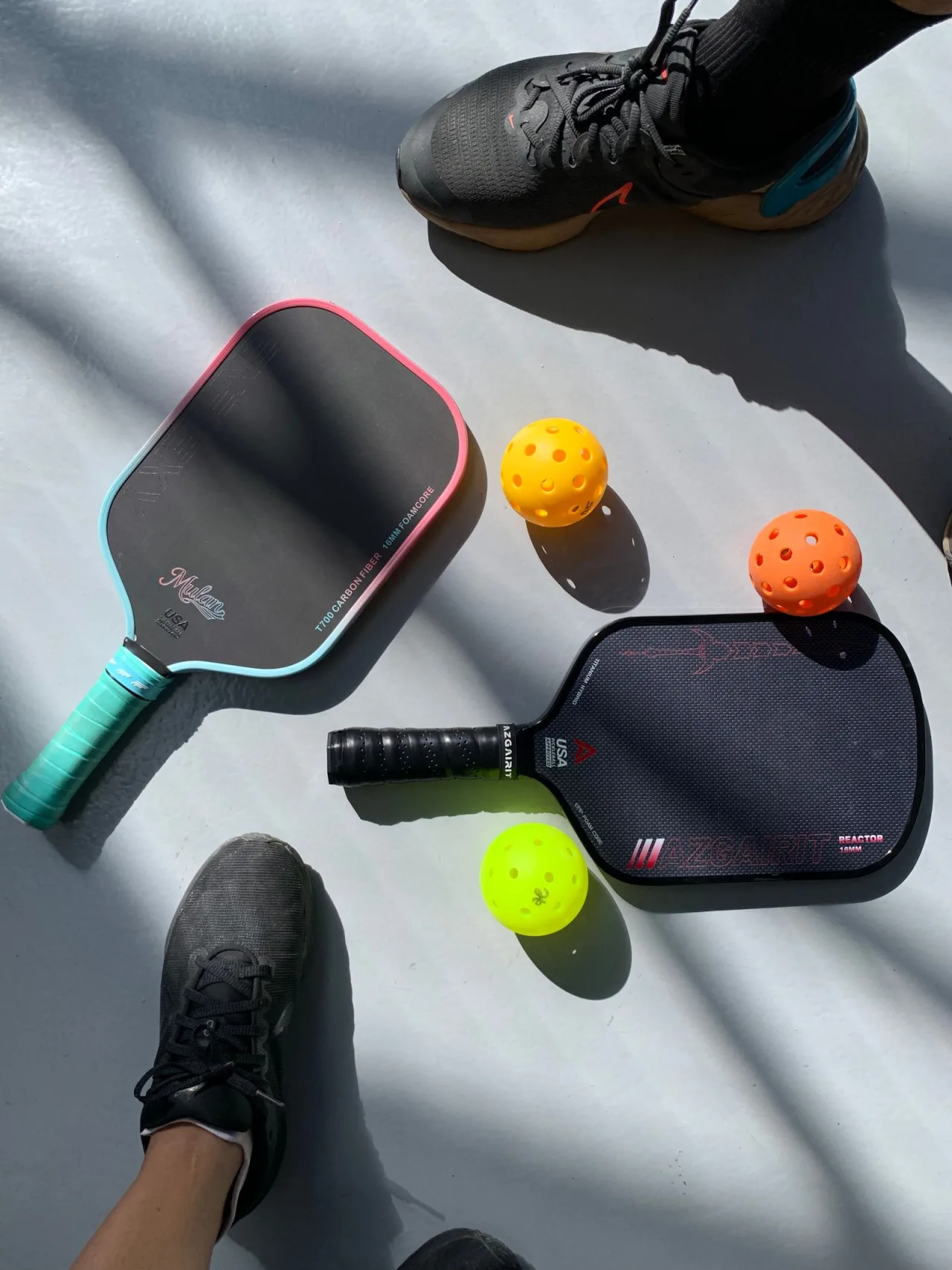
Your paddle is your primary way of interacting with the game. It's like an extension of yourself and your expression of your skill. In our article about the best pickleball paddles by level, your paddle must be appropriate to your skill on the court. It's not a matter of picking the most expensive or the latest generation, but having the correct paddle specs that would complement your play.
For example, many beginners are enticed to buy "power" paddles because this is what the pros use. Because of its construction (e.g. thinner cores), off-center hits twist the paddle in hand. This ends up popping dinks up high or spraying third-shot drops beyond the baseline. Beginners should focus more on finessing their technique, so a low- to mid-range paddle with a thicker core would be more forgiving.
This guide will help you how to choose a pickleball paddle. We will give you an overview of the right paddle specs you should be looking for (or pay attention to).
What Are You Looking for in a Pickleball Paddle?
To begin your search, you need to look at your current skill level, playstyle, and your budget. This will help you shortlist what you need in a paddle.
Level | What to look for | Feel |
|---|---|---|
Beginner | 16mm control core, high twist weight, widebody or hybrid, midweight | Forgiving. Mid budget, not premium |
Intermediate | All-court or spin, hybrid shape, the sweet-spot brands | Adds weapons without losing control |
Advanced | Gen-3 or 4 foam, elongated, top Firepower | A ceiling. Mind durability and legality |
You Don't Need to Buy an Expensive Paddle
It is tempting to buy into the hype of new-generation paddles. As we have established at the beginning of this article, what you need most is a paddle that aligns with your skill and playstyle. Across the big testing databases, many mid-range paddles score the same for spin and power when compared to paddles almost twice their price. Sure, a premium paddle buys a little more pop, a nicer feel, and better durability, but it does not buy you a better third shot.
If you are a beginner or a typical rec player, a mid-priced paddle is the right call, full stop. We break down exactly what changes at each price point in our guide to whether expensive paddles are worth it.
Pickleball Paddle Specs
Perhaps the most critical criteria for choosing the right paddle is its specs. This dictates how the paddle feels overall. For a more in-depth view of these specs, you can read our guide.
1. Paddle Weight (Most Critical Feature)
Weight affects your hand speed, power, and physical fatigue. Paddles are categorized depending on their static weight:
- Lightweight (< 7.3 oz): Offers high maneuverability and fast hands at the kitchen line, making it ideal for players with wrist/elbow pain. However, it requires more arm effort to generate depth and power. Lightweight paddles are ideal for beginners because they're easy to maneuver.
- Mid-weight (7.3 – 8.0 oz): The sweet spot for 80% of players. It balances power, speed, and shot control with minimal joint strain. Mid-weight is ideal for both beginners and intermediate players because of its flexibility.
- Heavyweight (> 8.0 oz): Delivers maximum drive power and stability on off-center hits. However, it has slower reaction time during fast net exchanges. Heavy paddles are geared for advanced players because it adds mass to the throat or perimeter to increase stability against hard hitters. The heaviness also expands the sweet spot, accepting a slight drop in hand speed for maximum plow-through and block stability.
Paddle weight dictates two main physics trade-offs: mass equals power/stability, but less weight equals hand speed and reaction time. Here is how to match paddle weight to specific playstyles and skill levels.
Playstyle | Recommended Weight | Primary Objective | Key Advantage |
Dink & Reset Specialist (Control/Soft Game) | 7.3 – 7.7 oz (Light to Mid) | Quick hand speed, soft touch, and effortless kitchen battles. | Rapid positioning during fast hand battles at the net; easier to absorb hard hits with soft hands. |
All-Court / Hybrid (Balanced Offense/Defense) | 7.8 – 8.2 oz (Mid-Weight) | Versatility across all zones—dinking, third-shot drops, and put-aways. | The optimal balance of control and plow-through power without causing fatigue. |
Power Drive & Aggressive (Baseline / Singles) | 8.2 – 8.6+ oz (Heavy) | Deep baseline drives, aggressive overheads, and passing shots. | Maximum momentum transfer ($F = ma$); the paddle does the work on drives and resists twisting on off-center hits. |
2. Core Thickness (Control vs. Pop)
Most high-performing paddles use a polypropylene honeycomb core. Thickness dictates how the ball leaves the paddle face:
Core Thickness | Primary Performance Characteristic | Best Playstyle Match | Key Trade-off |
16mm Control Core (Most Common) | Maximum Control & Touch: Absorbs shot momentum, making third-shot drops, dinks, and resets much easier to land cleanly. | • Soft-game & kitchen specialists. • Defensive counters & resets. • Reset-heavy doubles players. | Requires more physical effort on your swing to generate baseline drive power. |
14mm Balanced Hybrid | Speed & Pop Hybrid: Slightly lighter and faster through the air, with punchier put-aways than a 16mm. | • All-court players. • Speed-up-heavy aggressive players. • Players looking for fast net hands. | Slightly smaller sweet spot and less absorption on hard incoming shots. |
13mm Power Core | Maximum Pop & Power: Blazing ball speed off the face with minimal dwell time. | • Pure power hitters & baseliners. • Singles pickleball players. • Tennis crossovers with built-in touch mechanics. | Highly unforgiving; mis-hits pop up easily and touch shots require precise hand control. |
In terms of skill level, beginners should choose thicker cores (16mm) because it has a wide sweet spot and dampen ball rebound, giving you a wider margin of error while you master touch shots. Intermediate players can opt to use thicker cores for the same reason, but you can switch to 14mm if you find yourself struggling to finish points or want extra speed for fast volleys.
Advanced players have better flexibility in choosing the core thickness. At this level, it boils down to preference and playstyle:
- Select 13mm/14mm if your strategy centers around aggressive speed-ups, high spin, and forcing fast hand battles.
- Select 16mm if you prefer absorbing opponent power, resetting hard drives into the kitchen, and out-grinding teams in long rallies.
3. Face Material (Spin & Feel)
Face material determines spin, ball speed (pop), texture, and how the ball feels at contact. Selecting a surface material comes down to balancing texture for spin against elasticity for power.
Paddle faces are made from a variety of materials:
- Raw Carbon Fiber (Toray T700 / 3K / 18K): The modern gold standard. It offers a grittier texture to bite into the ball for maximum spin control and soft touch. Overall, it feels muted, plush, and connected. The naturally textured weave acts like sandpaper, grabbing the ball to impart massive topspin or slice. It is best for players who rely on heavy topspin drives, rolling dinks, drop shots, and tactical placement
- Raw Kevlar and Carbon Kevlar Hybrids: best for control-oriented players who want elite spin with a slightly softer, more forgiving impact than pure carbon. The Kevlar weave adds durability while softening the impact feel, expanding the sweet spot and dampening harsh vibrations before they reach your arm.
- Fiberglass (Composite): Flexible and springy, generating higher "pop" and natural power at a lower cost. Fiberglass flexes under impact and acts like a catapult, firing the ball back with very little physical effort. Ideal for players who need help generating deep power, or players who love punchy net volleys and put-aways.
- Standard Graphite: Lightweight, stiff, and highly consistent for placement players. The ball rebounds quickly off the face with minimal flex. It's great for touch players who prioritize precise placement over heavy spin or raw power.
4. Paddle Shape
Paddle shape determines reach, sweet spot size, maneuverability, and leverage for power. USA Pickleball limits total paddle dimensions (Length + Width) to less than or equal to 24 inches. This means, every shape is a trade-off between length and width.
Skill Level | Primary Need | Best Shape Choice | Key Reason |
Beginner (2.0 – 3.0) | Forgiveness & Consistency | Standard / Widebody | Provides the largest sweet spot so mis-hits stay in play while stroke mechanics improve. |
Intermediate (3.5 – 4.0) | Versatility & Spin | Hybrid or Standard | Offers extra reach without sacrificing the fast hand speed needed for kitchen firefights. |
Advanced (4.5+ Offense) | Power, Whipping Spin & Reach | Elongated | Maximize leverage on serve returns, baseline drives, and put-away overheads. |
Advanced (4.5+ Defense/Reset) | Soft Touch & Net Speed | Standard / Widebody | Maximizes paddle width for defensive blocking against hard drives. |
What are long handle handle/ blade shapes? These are paddles that extend the grip length while reducing the overall face area to fit USAP dimension rules. It is ideal for players who execute two-handed backhands or two-handed counter-attacks at the kitchen. |
Control vs Power vs All-Court
Control, Power, and All-Court are paddle categories based on how their physical construction balances energy absorption versus ball launch speed. These categories are defined by their distinct engineering specifications (e.g. core thickness, shape, weight, and face materials as mentioned above).
1. Control Paddles (Touch & Resets)
Control paddles are built to absorb incoming ball energy, providing a soft, plush feel that makes it easier to keep dinks low, drop third shots into the kitchen, and reset hard opponent drives.
The ball feels like it sinks into the paddle face (high dwell time). You get minimal trampoline effect, which means mis-hits are unlikely to pop up high over the net. However, you must supply your own power when driving from the baseline.
Typical Specs:
- Core Thickness: 16mm (or thicker)
- Core Material: Un-thermoformed polypropylene honeycomb
- Face Material: Raw Carbon Fiber or Kevlar hybrid (for high spin and ball pocketing)
- Shape: Standard / Widebody (large sweet spot, low swing weight)
2. Power Paddles (Pop & Drives)
Power paddles prioritize ball velocity, pop, and leverage. They convert maximum kinetic energy back into the ball with fast rebound speeds. It is crisp, loud, and immediate. The ball explodes off the face with minimal dwell time. This makes punch volleys, speed-ups, and baseline drives fast with less swing effort, but delicate kitchen dinks require a very light touch.
Typical Specs:
- Core Thickness: 13mm – 14mm (thin core)
- Construction: Thermoformed / foam-injected edges (adds rigidity)
- Face Material: Fiberglass, composite, or stiff graphite
- Shape: Elongated (16.5" length gives higher swing weight and leverage)
A common mistake for many players is opting for power paddles when they need more control. Most rec players lose far more points to their own errors than they ever gain from extra pop. If you are unsure how spin fits in, check out spin vs control vs power.
3. All-Court Paddles (The Balanced Hybrid)
All-Court paddles bridge the gap. They use modern thermoforming and foam-edge perimeter weighting to give you solid pop on drives while maintaining enough core thickness for soft dinks and resets. Offers ~80% of the plush touch of a control paddle alongside ~80% of the drive speed of a power paddle. It handles fast kitchen exchanges while still giving you confidence on delicate third-shot drops.
Typical Specs:
- Core Thickness: 14mm or 16mm (often thermoformed)
- Face Material: Raw Carbon Fiber
- Shape: Hybrid / Curved (e.g., 16.25" × 7.75")
Pickleball Paddle Generations
In contrast to what others may think, paddle generations describe more about the manufacturing eras defined by how the core, edges, and face are constructed. Understanding paddle generations helps explain why two paddles made of the same materials can feel and play completely differently.
Generation | Key Manufacturing Feature | Primary Feel | Sweet Spot | Typical Price Range |
Gen 1 / 1.5 | Cold-pressed sandwich (glued) | Soft, plush, muted | Standard | $40 – $100 |
Gen 2 | Thermoformed unibody + edge foam | Crisp, poppy, powerful | Large & Stable | $100 – $180 |
Gen 3 | Thermoformed + propulsion foam cores | Explosive, trampoline pop | Very Large | $200 – $280 |
Gen 4 | Full engineered foam core (no honeycomb) | Consistent, dampened, solid | Massive (Full face) | $220 – $300+ |
- Gen 1: Cold-pressed assembly. A polymer honeycomb core is sandwiched between two flat sheets of fiberglass, graphite, or carbon fiber, held together by glue and an exterior edge guard. It is best for beginners and traditional touch/reset players.
- Gen 2: Thermoformed with sealed edges for more power, but the thin cores were prone to core crush, where the honeycomb compresses into dead spots. The paddle also drifts over the legal power limit. Great for a vast majority of intermediate to advanced players (3.5+) looking for an all-court or power-hybrid setup.
- Gen 3: Thermoforming combined with dynamic internal foam systems. Instead of relying solely on rigid honeycomb cores, Gen 3 paddles integrate decoupled inner cores, specialized foam channels, or flexible propulsion layers. Ideal for advanced power hitters who prioritize aggressive speed-ups, put-aways, and singles play.
- Gen 4: Eliminates the traditional polypropylene honeycomb core. Gen 4 utilizes solid or multi-density, high-grade engineered foam cores wrapped in multi-layer compression carbon. Players seeking ultimate consistency, low vibration, and maximum paddle longevity without sacrificing drive speed should pick a Gen 4.
Buying a Paddle in Southeast Asia
If you are in Malaysia, the largest pickleball market in Asia, we cover which paddles you can actually buy, real prices in Ringgit, the authorized shops, and the import tax math in our guide to the best pickleball paddle in Malaysia. Before you buy anything on a marketplace, read how to spot a fake paddle on Shopee and Lazada.
Pick your level, your style, and your budget. Buy an all-court paddle in the mid price range unless you have a clear reason not to. Ignore the generation hype, and check it is real and approved before you pay. That gets 90 percent of players the right paddle.
Common questions
What pickleball paddle should a beginner buy?
A midweight, 16mm control-core paddle with a widebody or hybrid shape and a high twist weight, in the mid price range. Forgiveness matters far more than power when you are starting. You do not need a premium paddle.
Is a more expensive pickleball paddle better?
Only a little, and mostly for advanced players. Many paddles near 100 dollars match far pricier ones on spin and power in lab testing. A premium paddle buys marginal pop, feel, and sometimes durability, not skill.
What is the difference between a 14mm and a 16mm paddle?
14mm cores are thinner and pop more, but wear faster and crush sooner. 16mm cores give more control and a bigger, more forgiving sweet spot. Most players are better served by 16mm.
What does paddle twist weight mean?
It measures how much the paddle resists twisting on off-center hits. A higher twist weight, around 6.6 and up, means a larger effective sweet spot and fewer mishits. It is the forgiveness spec most buyers overlook.
How do I avoid a fake paddle on Shopee or Lazada?
Buy from authorized sellers, be suspicious of prices that look too good, and check for a serial or QR code and the correct weight. See our full guide to spotting fakes.
More paddle guides
Go deeper on any part of choosing a paddle: