
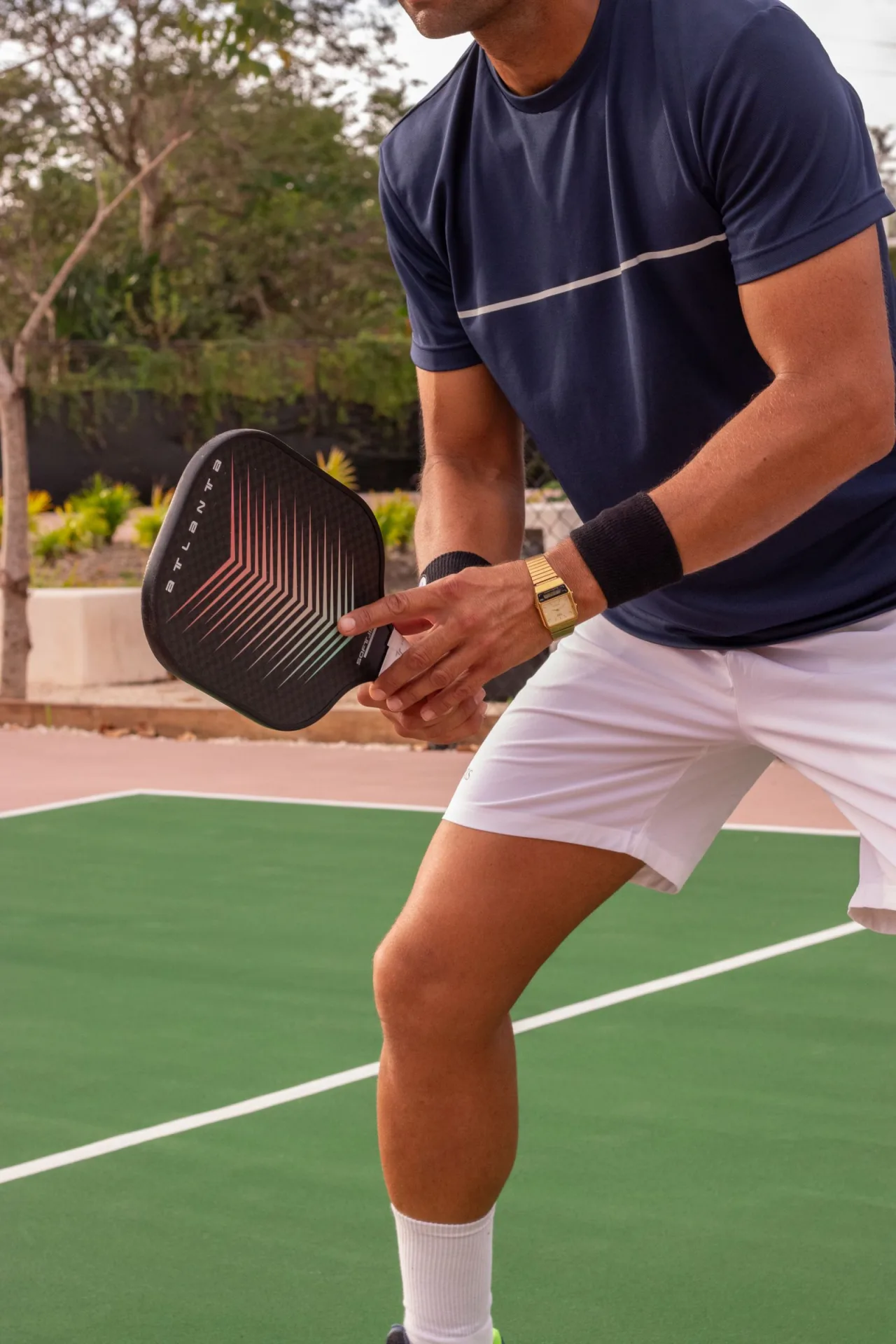
Every pickleball paddle balances three core mechanics: Power, Control, and Spin. Your paddle’s balance of power, control, and spin defines your tactical capabilities on the court:
- Power gives you faster drives and put-aways at the cost of a smaller sweet spot and more pop-ups.
- Control lets you absorb a heavy pace and place delicate third-shot drops into the kitchen, but it requires extra arm effort for depth.
- Spin allows you to hit aggressive arcs that stay in bounds while giving opponents tricky bounces to deal with.
Selecting the right combination ultimately comes down to whether you want to overwhelm opponents with speed, outlast them through mistake-free consistency, or shape the ball's trajectory to dictate play.
In this guide, we will go over these three aspects so you can choose the best paddle according to your playstyle. Check our guide for a more comprehensive guide on how to choose a pickleball paddle.
Power Paddles
A power paddle has a thinner or foam core, often a head-heavy or elongated build. Designed for high exit velocity, aggressive drives, and overhead put-aways with minimal effort required from the arm. They are made for singles players, bangers, and players who want effortless depth on their shots.
Power paddles have thinner polymer cores (1mm – 14mm). A thinner core compresses less upon impact, transferring energy immediately back into the ball for maximum "pop". Their face material is often made from fiberglass, composite, or foam-injected thermoformed carbon fiber edge walls that act like a catapult. In terms of shape and feel, they are often elongated with head-heavy balance (higher swing weight) to give extra leverage on drives.
Why the Power Obsession is Usually a Mistake
On the forums, most recreational players lose far more points to their own unforced errors than they ever win with extra pop. A power paddle amplifies your mistakes as much as your winners. Until your control is solid, more power makes your results worse, not better. Improving your rating comes from consistency, which is why our guide on improving your DUPR rating barely mentions equipment
Control Paddles
A control paddle has a thicker core (usually 16mm), a higher twist weight for a bigger sweet spot, and a softer feel that absorbs pace. You get predictable resets, patient dinks, and fewer pop-ups off hard shots. This type of paddle is made for defensive players, doubles strategists, and those focusing on unforced error reduction, third-shot drops, and resets.
Control paddles have thicker polymer cores (16mm – 19mm). The thicker honeycomb structure absorbs kinetic energy, allowing the ball to sink deeper into the face (dwell time). They are often made from raw carbon fiber (such as Toray T700) or muted composite surfaces that dampen harsh vibration. Control paddles have standard or widebody shapes with a low swing weight, yielding a much larger sweet spot and faster hands at the kitchen line.
However, the trade-off is that you have lower natural ball speed. Players must generate their own power on deep drives and put-aways. For most players under 4.0 who win points with steadiness, this is the right choice, and is what we recommend for beginners.
Spin-Focused Paddles
Spin is separate from the power-control axis. It comes from a gritty surface plus your swing speed, and the labs measure it in RPM. John Kew's tiers put top paddles at 2,200 RPM and up, mid from 1,800 to 2,199, and low below that.
Spin tier | RPM | In play |
|---|---|---|
Top | 2,200 and up | Sharp dinks, dive-bombing serves, heavy topspin drives |
Mid | 1,800 to 2,199 | Plenty for most players |
Low | Under 1,800 | Fine for a control-first game |
Spin-focused paddles are engineered with raw textures or friction coatings to grab the ball's plastic skin and generate high revolutions per minute (RPM). It is best for aggressive all-court players who rely on topspin shapes to hit hard while keeping the ball in bounds. However, the raw carbon grit can lose a real part of its bite within a month of heavy play. If you play often, weight durability is key. The full mechanics are explained in our guide about paddle specs.
Spin-focused paddles are made with mid-to-thick cores (14mm – 16mm) so the ball stays on the face long enough for the surface grit to impart rotational force. To maximize the surface friction, spin-focused paddles are often made with microscopic peel-ply raw carbon fiber, sprayed quartz grit, or textured resin layers.
What are All-Court Paddles?
All-court paddles sit in the middle, and they are the most popular type for a reason. They sit directly between pure power paddles and pure control paddles. They are designed to give you enough pop and drive speed for aggressive plays without sacrificing the touch, stability, and soft-game forgiveness needed at the kitchen line.
Rather than maximizing one extreme metric, an all-court paddle blends construction elements so you don't have to adjust your mechanical stroke to compensate for missing control or power.
Matching your Playstyle with the Right Paddle
Here are some questions to help you determine the right paddle:
- Do you win points by out-steadying people, or by hitting through them? Steady means control. Hitting through means power.
- How is your consistency under pace? Shaky means control or all-court. Solid means you can handle power.
- Are you under 4.0 or unsure? Then all-court, every time.
When you have your type, the specific picks are in the best pickleball paddles by level roundup. Power is the most marketed spec and the most overrated for most players. Control wins recreational pickleball. Buy the paddle that keeps the ball in, not the one that hits it hardest.
Common questions
Should a beginner use a control or power paddle?
Control, or all-court at most. A power paddle amplifies the pop-ups and errors that beginners already make. A forgiving control paddle helps you keep the ball in and improve faster.
What is the difference between control and power paddles?
Control paddles have thicker cores, bigger sweet spots, and a softer feel for resets and dinks. Power paddles have thinner or foam cores and a livelier face for driving and finishing, at the cost of control and forgiveness.
Can a paddle have both spin and control?
Yes. Spin is separate from the power-control axis, so many control and all-court paddles also generate high spin. Look at both the Firepower band and the spin RPM tier.
Why do the pros not all use power paddles?
Because control and consistency win rallies. A growing number of pros use all-court paddles, and even power players prize spin and touch over raw pop.