
Much like buying a phone or a laptop, pickleball paddles have specs or specifications that can affect how you play. This can cover size, weight, shape, materials, grip, and performance-related characteristics.
In this guide, we will define what these specs are and how they can change the way you play. The thresholds come from John Kew, whose lab publishes defined ranges for every measurement. You can also read our guide on how to choose a pickleball paddle for more information on how to pick out your paddle based on your playstyle.
Core Physics
The core dictates how much energy is returned to the ball (power/pop) versus absorbed (control/dink stability). It is controlled by core thickness and material.
Core Thickness
Core thickness is widely considered the single most influential spec determining whether a paddle plays like a control paddle or a power paddle. Because modern pickleball cores are overwhelmingly made of polypropylene honeycomb, changing the core depth directly alters how much energy is absorbed versus returned to the ball upon impact.
Core | Range | What it does |
|---|---|---|
Thin | 10mm - 13mm | Because thin cores have less depth to compress, they don't absorb much impact energy. Instead, the ball compresses quickly against a stiff backing and rebounds off the face at high velocity. This creates "pop" which is great for fast counter-attacks, punch volleys, and aggressive drives. |
Thick | 15mm - 20mm | A thick core has more material depth to compress under ball impact. It absorbs kinetic energy rather than instantly reflecting it, resulting in lower exit speed off the paddle. This allows you to swing harder on dinks or drops without fear of popping the ball up high into your opponent's attack zone. |
Core thickness also influences other aspects of the paddle such as:
- Dwell Time: refers to the split-second duration the ball stays compressed against the paddle face during impact. Thick cores have longer dwell time, allowing you to "hold" and guide soft dinks (dinks, resets, third-shot drops) where you want them. On the other hand, thin cores have shorter dwell time, requiring precise hand softness and timing to control soft kitchen play.
- Sweet Spot and Forgiveness: Core thickness directly dictates the size and uniformity of a paddle's sweet spot. Thicker cores have larger sweet spots with deeper honeycomb structures that distribute impact force on a wider area of the paddle. Off-center hits maintain velocity and accuracy far better, making it exceptionally forgiving. Meanwhile, thinner cores have a concentrated sweet spot. If you strike the ball near the edge guard on a thin paddle, you will feel significant twisting (torsional flutter) and a sudden loss of ball depth.
- Feel & Vibration Dampening: Thicker cores have excellent shock absorption and reduce arm impact and wrist vibration, which makes them ideal for players who experience strain. Thinner cores have more feedback and vibration transfer to your hands, wrist, and forearm.
Core Material
Although core thickness determines energy absorption and sweet spot depth, the core material dictates how this energy is transferred. In turn, it determines how the paddle feels on impact, including its loudness and durability.
- Polypropylene Honeycomb (PP): The standard core in modern play. Quiet, durable, and balanced between pop and control.
- Full Foam / Expanded Foam Cores: Becoming popular in high-end tech. Replacing or supplementing honeycomb, foam cores offer exceptional energy transfer consistency, dampening, and resistance to "core crush".
- Nomex (Aramid Fiber): Hard, loud honeycomb structure.Offers maximum pop and stiffness but minimal control and a harsh feel.
- Aluminum: Lightweight with great control, but prone to denting over time. Rare in high-performance paddles.
Surface Technology (Spin and Feel)
There are three ways the surface of your pickleball face can affect your play:
- How much spin you can impart to the ball
- How predictable your launch angle will be
- How long your paddle maintains its performance before losing its grip
Because pickleball balls are made of hard, smooth plastic, the interaction between the paddle face and the ball happens in milliseconds. Surface materials and textures determine whether the ball bites or slips off the face.
Here are common surface materials often used in a pickleball paddle's face:
- Raw Carbon Fiber (T700 / 3K / 12K / 18K): Uncoated, textured carbon fiber face. The textured weave grabs the ball's plastic shell to maximize RPMs on drives and cuts. T700 raw carbon fiber remains the benchmark for spin-oriented, control-minded players.
- Fiberglass (Composite): More flexible than carbon fiber, creating a "trampoline effect" that propels the ball back with extra power, though with slightly less spin consistency and a smaller sweet spot.
- Graphite: Extremely thin, lightweight, and rigid material. Excellent for touch, fast resets, and placement, but lacks the raw power of fiberglass.
Peel Ply Texture vs Spray On
How materials are applied to a surface of a paddle is also a crucial factor that can affect your game. It determines whether a paddle keeps its spin for a full season of heavy play or loses its bite within a few weeks.
The two dominant methods in the market:
Surface Application | Details | Performance and Wear Profile |
Peel Ply Texture | "Peel-ply" refers to a manufacturing technique borrowed from aerospace composites. It is the standard process behind almost all legitimate Raw Carbon Fiber (RCF) paddles on the market today. | Spin Mechanics: Creates a uniform, cross-hatched micro-roughness that grabs the plastic ball on impact across all stroke angles. Durability: Exceptional. Because the grit isn't glued or painted on top of the paddle face (it is the paddle face), it doesn't flake off. Wear Degradation: Wear occurs very gradually as the microscopic resin peaks slowly flatten down over hundreds of hours of play. There are no abrupt "bald spots". Feel: Yields a soft, control-oriented, and predictable contact feel with a matte finish. |
Spray On | Applied grit is an additive coating process commonly found on budget-friendly paddles, older graphite/composite builds, or paddles prioritizing bright, full-surface graphics. | Spin Mechanics: Out of the box, high-end spray-on coatings can deliver equal or higher initial friction than peel-ply, creating aggressive initial spin. Durability: Low to moderate. Because the abrasive particles sit in a thin topical layer over a smooth paddle face, the repeated impacts of hard plastic balls shear the particles off the resin substrate. Wear Degradation: Experiences a sharp "cliff" in performance. Within 1 to 3 months of regular play, the high-contact zone in the center of the paddle becomes noticeably smooth or polished, leading to sudden drops in spin. Feel: Rougher, sandpaper-like tactile feel straight out of the packaging. |
Embedded "Durable Grit" Technologies
Because traditional peel-ply resin can still smooth out after long-term wear, many modern brands utilize hybrid grit technology.
Rather than spraying sand over paint, these processes embed hard abrasive particles (like silicon carbide, ceramic dust, or diamond particles) directly into the peel-ply epoxy matrix during hot-press molding. As the top micro-layer of resin wears, fresh embedded grit particles are continuously exposed, extending high-level spin life even longer.
Geometry, Weight & Dynamics
Paddle geometry, weight distribution, and dynamic stability govern how a paddle feels in your hand, how quickly you react at the kitchen, and how much power or forgiveness you get.
Paddle Geometry & Outline Shapes
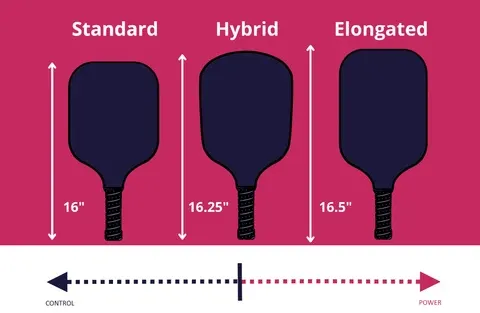
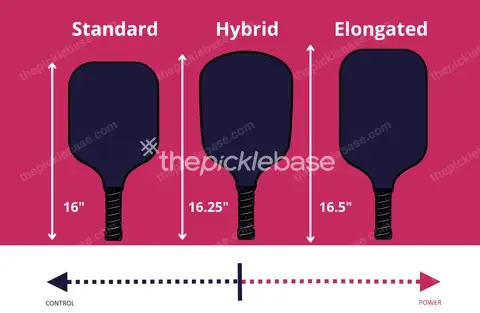
Under official USA Pickleball (USAP) standards, the combined length + width of a paddle cannot exceed 24 inches, and the maximum length cannot exceed 17 inches. Brands allocate this square inch perimeter into three primary outline profiles:
- Elongated (~16.5" L x 7.5" W): Provides you with maximum power, extra court reach, and increased whip leverage. However, mass is pushed farther from your hand. This inherently raises the swing weight, making reaction time slightly slower during fast firefights at the kitchen, while narrowing the sweet spot side-to-side.
- Widebody/ Standard (~15.5" to 16" L x 8" W): Maximum side-to-side forgiveness and faster hand speed. However, it has shorter reach and less natural leverage/power on overheads and baseline drives. Widebody paddles are highly favored by kitchen reset specialists and players seeking maximum stability on off-center hits.
- Hybrid/ Tear-drop (~16.25 L x 7.5" - 7.75" W): Considered the "Goldilocks" shape for pickleball paddles. It curves slightly toward the top corners to maintain a 16.25-inch reach while shifting mass inward to lower swing weight. Tear-drop paddles offer high hand speed paired with a generous sweet spot.
Newer players should stay with a widebody or hybrid paddle. Elongated suits players who already have control and want reach and extra power on drives and serves.
Paddle Mass and Mass Dynamics
A pickleball paddle's weight also has a direct impact on its performance. However, it's not just about its static weight but also its mass dynamics or how weight is being distributed across the paddle.
Static Mass/ Weight
Static weight (measured in ounces or grams on a standard scale) represents the absolute physical mass of the paddle. Static weight is the primary factor driving overall muscle fatigue during long play sessions.
Pickleball paddles are divided into three weight classes:
- Light (7.2 – 7.7 oz): Max maneuverability, fast hands, but lower power stability. Ideal for players with lower wrist/shoulder strength or those playing 3–4 hours at a stretch.
- Midweight (7.8 – 8.2 oz): The Goldilocks range for power and speed.
- Heavyweight (8.3+ oz): Massive plow-through, high power, but higher wrist/elbow fatigue.
The higher the static weight, the more momentum. When blocking a hard drive from an opponent, a heavier paddle acts like a solid wall. It absorbs the shock of incoming speed and returns deep, stable counter-attack shots with minimal physical effort.
Meanwhile, low static weight means recoil. A light paddle is easily pushed backward by heavy incoming drives, requiring you to hit through the ball with more personal muscle force to get depth.
Mass Dynamics
A pickleball paddle's weight distribution has an effect on how it behaves in motion. Two paddles can weigh the same 8.0 ounces on a static scale, yet play completely differently on the court. One might feel sluggish at the net, but blast drives from the baseline, while the other feels light as a feather for quick reaction volleys.
This difference in weight distribution is called mass dynamics. In pickleball, there are three primary dynamic properties:
Swing weight is how heavy the paddle feels while you swing it. It predicts play better than static weight.
- Low SW (<112): Lightning-fast reaction speed at the kitchen, but lower energy output on drives.
- Medium SW (113–119): Balanced speed and drive depth ideal for all-court play.
- High SW (120+): Massive power and baseline plow-through, but slower during fast hand exchanges.
Twist weight (TW) measures how much the paddle resists twisting when you hit off-center:
- Low TW (<5.9): High torque on off-center hits. The paddle twists in your hand, deadening ball speed and sending resets wide or into the net.
- High TW (6.8+): Exceptional forgiveness. The paddle face stays square on mishits near the edge guard, effectively enlarging the sweet spot.
Balance Point is the physical fulcrum along the length of the paddle (measured in centimeters from the butt cap).
- Head-Heavy (>24.5 cm): Acts like a hammer. It generates high power with less swing effort, but puts higher stress on the tendons in your forearm and elbow.
- Head-Light (<23.8 cm): Moves easily and reduces joint fatigue, making it preferable for players managing or recovering from tennis elbow.
Handle Length and Grip Size
Handle specifications are often overlooked, yet they serve as your primary physical interface with the paddle. A paddle's handle geometry directly controls lever arm mechanics, two-handed ergonomics, swing weight perception, and wrist articulation.
Handle Length
Handle length typically ranges from 4.5 inches to 6.0 inches. Because total paddle dimensions are capped at 24 inches, lengthening the handle directly steals surface area from the paddle face. There are three types of handle lengths for pickleball paddles:
Handle Length | Best for | How it plays |
Short Handles (4.5″ – 5.0″) | Traditional one-handed backhand players, table tennis converts, and kitchen reset specialists. | Brings the center of mass closer to your hand, lowering the paddle's effective swing weight. Maximizes hitting surface area and sweet spot size. Delivers high maneuverability and fast hand speed during kitchen exchanges. |
Standard Handles (5.0″ – 5.25″) | Flexible and can accommodate any type of player | Accommodates one-handed grips comfortably while allowing a tight two-handed grip on drops or drives for players with smaller hands. |
Extended Handles (5.25″ – 6.0″) | Tennis converts and players who rely on aggressive two-handed backhand drives and counters. | Acts as a longer lever arm. The extra distance increases head speed at the tip of the paddle during a full swing. Essential for comfortable two-handed backhands. The increased leverage generates higher power on serves, overheads, and drives, but slightly raises swing weight and reduces overall face surface area. |
Grip Circumference
Standard grip circumference ranges from 4.0 inches to 4.375 (4 3/8) inches. This spec is essential for mechanics and joint health. There are two types of grip size you can choose from:
- Smaller Grips (4.0″ – 4.125″): Allows your fingers to wrap deeper around the handle, giving your wrist maximum mobility to snap on serves, roll dinks, and generate top-spin. However, it requires higher squeeze pressure to keep the paddle from twisting on off-center hits, which can lead to forearm fatigue.
- Larger Grips (4.25″ – 4.375″+): Spreads grip pressure across more palm surface area, allowing you to maintain a relaxed grip. This stability stops the paddle from twisting in your hand on hard drives. But it restricts wrist flexibility slightly, making quick flick shots at the kitchen more reliant on arm movement.
Handle Customization Options
Grips are the easiest to customize in a pickleball paddle. As a rule of thumb, it is easy to make a small grip larger by adding an overgrip (each overgrip adds ~1/16″ to circumference), but virtually impossible to shave down a handle that starts too large.
Overgrips add cushion, sweat absorption, and subtle thickness. However, they need to be replaced frequently to maintain their tackiness. You can also add other customizations to your grips, including hesitation/hesacore grips. These are ergonomic silicone lattice replacement grips that replace standard stock tape. They feature ridged channels that fit natural finger joints, reducing vibration and grip tension.
Finding the Right Pickleball Paddle
Navigating pickleball paddle specs comes down to balancing a few critical variables that define how a paddle performs on the court. To understand how these elements work together, read our breakdown on spin vs. control vs. power in pickleball paddles. Surface technology further shapes playability, with peel-ply raw carbon fiber (T700) providing the structural grit needed for elite spin generation and consistent launch angles. These materials have evolved dramatically alongside manufacturing methods like thermoforming and foam-injected perimeters, which you can explore in detail in our guide on pickleball paddle materials and generations.
Beyond core and surface tech, mass dynamics like swing weight and twist weight dictate your hand speed at the kitchen and off-center forgiveness. If you're ready to find the perfect match for your skill level, check out our curated roundup of the best pickleball paddles or dive into full performance breakdowns across The Picklebase paddle directory.
Common questions
Is a 14mm or 16mm paddle better?
For most players, 16mm. It gives more control, a bigger sweet spot and better durability. 14mm pops more but wears faster and is less forgiving. With foam paddles, thickness no longer decides power.
What is a good twist weight for a pickleball paddle?
6.6 and above is high and very forgiving. Below 6.0 is low, with a small sweet spot that punishes off-center hits. Higher twist weight is almost always better for a developing player.
What is the difference between swing weight and static weight?
Static weight is what a scale reads. Swing weight is how heavy the paddle feels in motion and predicts play better. High swing weight (121+) means power and stability but slower hands; low (under 113) means quick and maneuverable.
How do I know my pickleball grip size?
Hold the paddle and check whether your other hand's index finger fits in the gap between your fingertips and palm. If it is tight, size up; if there is room to spare, size down. An overgrip lets you fine-tune.