
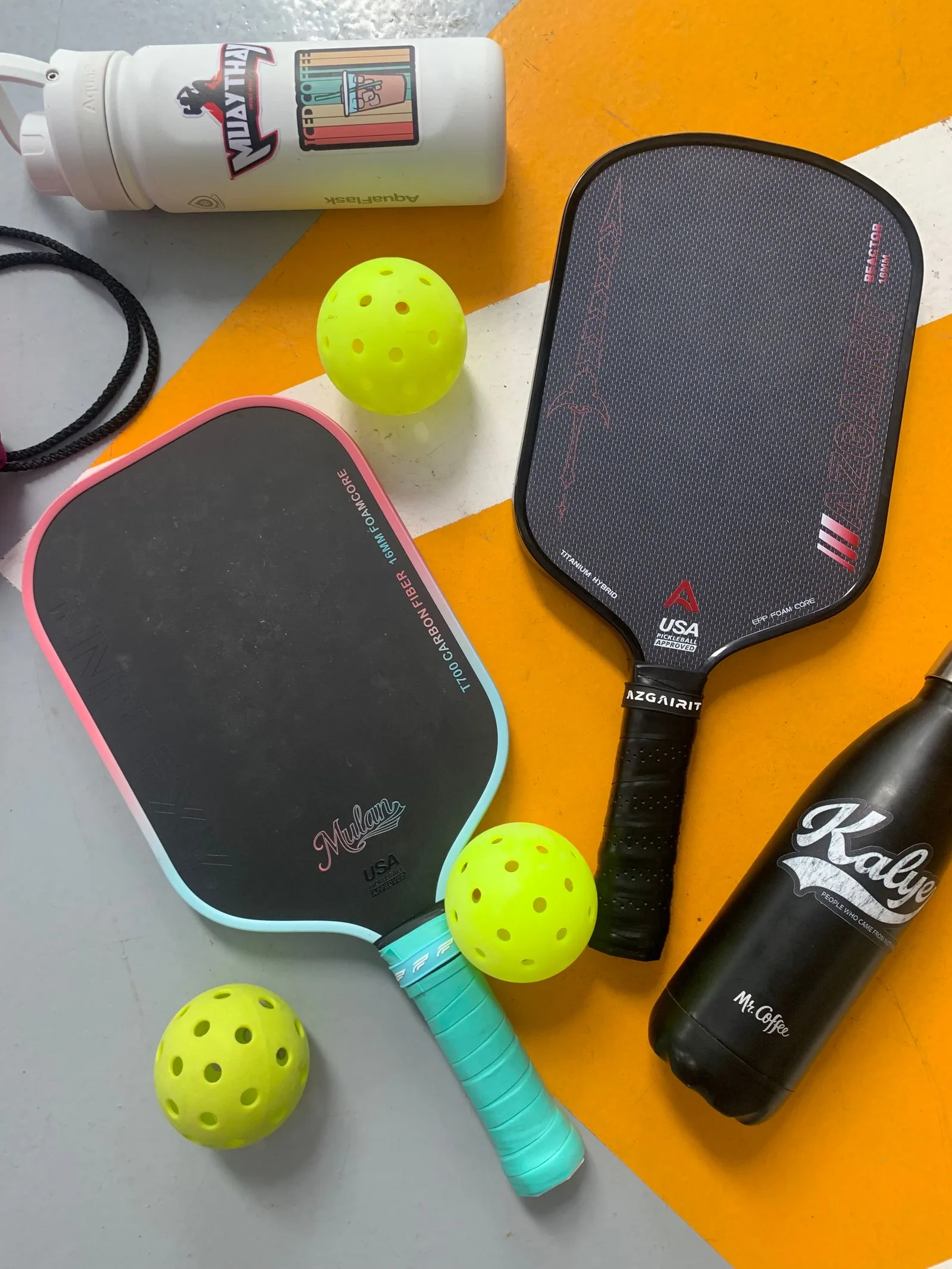
A paddle is a face bonded to a core. This construction decides its power, ball spin, and durability. It is also where the marketing gets loudest. Almost every paddle brand nowadays has a new generation with new face and core technology.
This guide explains pickleball paddle materials and generations. We will walk you through what matters when you buy so you get the best bang for your buck. You can check out our guide for an in-depth view of how to choose a pickleball paddle.
Paddle Faces: Carbon vs Fiberglass
The paddle face is the surface that hits the ball and dictates control, spin, and power of the ball. We covered paddle specs and how it affects spin, power, and durability through data.
There are currently two materials in the paddle market:
Face | What it gives you | Trade-off |
|---|---|---|
Raw carbon fiber | Control and grip for spin. The gritty texture bites the ball | The grit wears, so spin fades over time |
Fiberglass | More power and pop, a livelier face | Less control and touch on soft shots |
Carbon fiber faces are typically stiffer than fiberglass, so they flex less at impact and give a more predictable rebound angle and launch direction. That lower flex usually means less “trampoline” effect, which is why carbon often feels firmer and more precise. Raw carbon faces also tend to have a more durable textured surface, which helps create spin by increasing friction and preserving that texture longer.
On the other hand, Fiberglass faces are generally more flexible, so they bend a bit more on contact and then spring back. Players perceive this as an extra pop or easier power. In composite terms, that means more of the paddle’s energy return comes from elastic rebound rather than a rigid, controlled transfer. That same flexibility can make touch shots less predictable, but it can help on drives and put-aways.
In terms of durability, Carbon fiber is usually more resistant to surface wear in modern paddle builds, especially when the spin texture is part of the face itself rather than just a coating. Fiberglass paddles often rely more on surface coatings or grit for spin, and those coatings can wear down faster. So carbon tends to keep its playing characteristics longer, while fiberglass can lose texture and consistency sooner.
What is a Hybrid Paddle Face?
A hybrid paddle face is a combination of both fiberglass and carbon fiber. A common hybrid setup puts fiberglass in one layer and carbon fiber in another, or uses a carbon-textured outer surface over a fiberglass base. The idea is to keep some of the carbon’s control and spin while letting the fiberglass add a bit more pop and forgiveness. JOOLA describes one example this way:
A bottom layer of fiberglass with a layer of carbon on top for “the best of both worlds”.
However, hybrid builds don’t automatically beat a true carbon or fiberglass face in every category. They often narrow the gap, but the final behavior still depends on the core, thickness, surface texture, and the arrangement of the layers. Some hybrids are excellent compromises, but others end up feeling like a diluted version of both.
Which Paddle Face Material Should I Buy?
For most players, the best default is carbon fiber if you care about control, spin, and long-term consistency. Fiberglass makes sense if you want easier power and a softer, more forgiving feel, and a hybrid is the middle ground if you want some of both.
Pick carbon fiber if
- You play a lot of dinks, resets, third-shot drops, and placement-based points.
- You want stronger spin and a firmer, more predictable response.
- You’re willing to pay more for better durability and a more premium feel.
Pick fiberglass if
- You want more effortless pop on drives and put-aways.
- You prefer a softer, more forgiving face.
- Budget matters, and you’re okay giving up some spin and long-term texture retention.
Pick hybrid if
- You want a compromise: better control and spin than fiberglass, but more easy power than full carbon.
- You’re unsure whether your game needs a pure control paddle or a pure power paddle.
- You like versatility over specialization.
Paddle Cores: Honeycomb vs Foam
Underneath the paddle face is the core. The newer approach injects foam, either around the perimeter or through the whole core, which adds a trampoline effect and more power. Foam is the direction the sport is moving, and on Matt's Pickleball's power rankings, foam paddles now dominate the top.
Foam cores use a solid or molded foam structure instead of hollow cells, so they usually feel softer, quieter, and more dampened at contact. They often give you a larger effective sweet spot and better vibration absorption. This helps with resets, blocks, and other touch shots. Many newer foam paddles are also designed for better durability because foam can avoid the core-crush issues seen in some honeycomb builds.
Meanwhile, honeycomb cores are typically polypropylene cells, and they’ve been the standard for a long time because they’re versatile, relatively light, and affordable. They usually feel crisper and a bit more “poppy,” especially at lower swing speeds, which some players like for fast hands and easy depth. The tradeoff is that honeycomb can be louder and may be more vulnerable to dead spots or core crush over time.
Core Crush and Durability
The durability problem that arrived with thermoforming is core crush. Under pressure, a thin honeycomb core can compress into dead spots, so the paddle loses pop and consistency where you hit most. Thin 14mm cores are the most prone. JustPaddles has documented this well. On the surface side, raw carbon grit wears too, and John Kew's testing grades paddles by how much spin they lose, from under 5 percent to over 20. If you play often, treat durability as a real spec, not an afterthought.
Which Paddle Core Should I Pick?
Like with paddle face, your choice of core should be built around your play style. If your game is built around dinks, blocks, and resets, foam is usually the more comfortable option. If you want a livelier, more traditional response and don’t mind a bit more noise, honeycomb is the practical default.
- Pick foam if you want comfort, quiet play, and a more forgiving feel on soft shots.
- Pick honeycomb if you want a familiar feel, lighter weight, and often a lower price. For most players, honeycomb is still the safest mainstream choice, while foam is the more modern “premium feel” option.
Understanding Pickleball Paddle Generations
Pickleball paddle generations are a shorthand for major design eras. Keep in mind, however, that generations are not an industry standard and indicate how paddles are built. In turn, this affects power, control, feel, durability, and sometimes legality/performance limits.
Generation | Construction | The catch |
|---|---|---|
Gen 1 | Cold-molded honeycomb, glued in layers | Reliable but low power |
Gen 2 | Thermoformed with sealed edges for more power | Thin cores are prone to core crush, and drift over the legal limit |
Gen 3 | Thermoformed unibody with a foam-injected perimeter | The current mainstream. More pop, better durability than Gen 2 |
Gen 4 | Full-foam cores | The power ceiling, and the newest, priciest tier |
The labels matter because construction changes how the paddle behaves on contact. For example, honeycomb paddles tend to feel more traditional and balanced. Meanwhile, thermoformed paddles often feel more powerful and connected, and foam-based designs usually feel more dampened and stable. The tradeoff is that “newer” does not always mean better for your game; some players prefer the softer, more controlled feel of older-style builds.
Should You Pay for the Latest Generation?
Overall, you shouldn't choose a paddle just because it's considered newer. For most players, the value jump happens earlier than the “latest generation” jump, so a very new paddle is often paying for small gains, not a dramatic upgrade. Furthermore, the newest paddles are the least forgiving and the most expensive.
For example, a Gen-4 foam paddle is more powerful than a Gen-1, but power is the most overrated spec for most players. A Gen-3 all-court paddle in the mid price range is the right buy for the large majority of players. We put real numbers on the diminishing returns in our guide: Are expensive paddles worth it.
A good mid-tier paddle usually gives most of the performance benefit without the premium markup, and the returns get smaller as you move up the price ladder. In plain terms, spending from budget to mid-range often matters more than spending from mid-range to flagship.
When is it Worth It?
- You play often enough to notice subtle changes in feel, spin, and stability.
- You already know whether you want more power, more control, or a balance of both.
- You’ve outgrown your current paddle and can clearly identify what it lacks.
When is it Not Worth It?
- You’re new or still changing your style.
- Your current paddle is already comfortable and playable.
- You’d get more improvement from lessons, footwork, or match play than from a pricier paddle.
Common questions
What is a Gen 3 pickleball paddle?
A thermoformed paddle with a foam-injected perimeter around the core, which adds a trampoline effect for more power with better durability than the earlier thermoformed Gen 2 paddles. It is the current mainstream construction.
Are foam pickleball paddles better?
Foam cores add power and now top the lab power rankings, but they are not automatically better for you. They are the newest and priciest tier and tend to be less forgiving. Most players do better with a mid-priced all-court paddle.
What is core crush in a pickleball paddle?
When the honeycomb core compresses into dead spots under repeated impact, so the paddle loses pop and consistency. Thin 14mm thermoformed cores are the most prone. It is a durability risk worth checking before you buy premium.
Carbon fiber or fiberglass paddle: which is better?
Raw carbon fiber gives control and spin and suits most players. Fiberglass gives more power but less touch. Neither is simply better. Match it to whether you want control or power.