
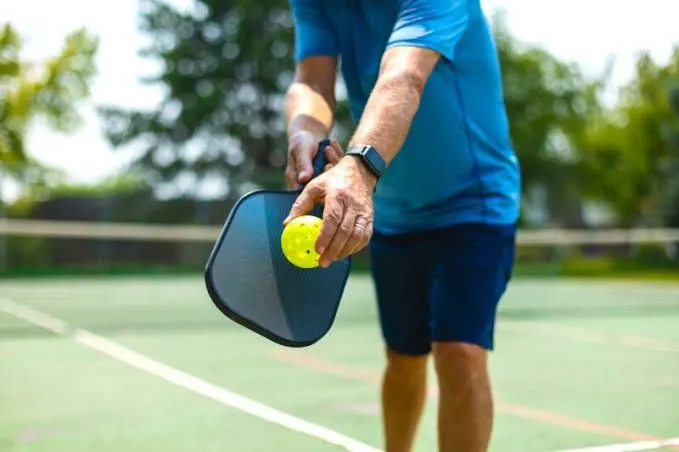
Every point in pickleball starts the same way. Someone stands behind the baseline, drops or tosses the ball, and puts it in play. Serving is important because if you get it wrong, you will basically hand your opponent a score even before the rally begins.
This guide walks through every rule that governs a legal pickleball serve, from where you stand to what counts as a fault.
Official Positioning Rules
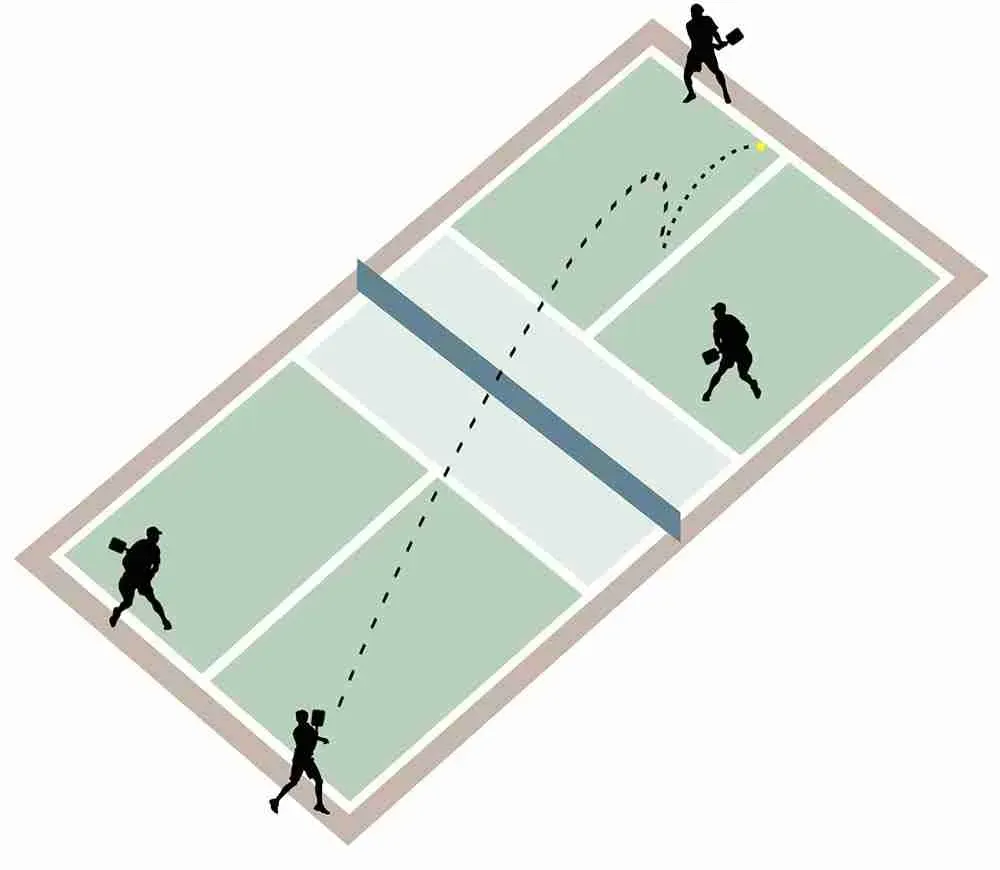
When serving in pickleball, your position relative to the court lines is strictly governed.
When your paddle contacts the ball, at least one foot must be touching the court surface strictly behind the baseline. Neither foot may touch the baseline itself, the court area inside the baseline, or the ground outside the imaginary extensions of the sidelines or centerline.
You can hover a foot over the line in the air, as long as it lands back down behind it before you strike the ball. Stepping on or over the baseline too early, even by a fraction, turns an otherwise clean serve into an automatic fault.
Our court lines guide breaks down every line on the court if you want the full picture before you start serving.
Common Positioning Faults Baseline Foot Fault: Stepping on or over the baseline before paddle-ball contact. Sideline Out-of-Bounds: Stepping on or beyond the imaginary extensions of the centerline or sideline during your serve motion. Both Feet Airborne: Jumping before contacting the ball so that neither foot is touching the ground behind the baseline at impact. |
Placement and Landing Zone
When serving in pickleball, placement is defined strictly by the boundary lines of the receiver's crosscourt service court. A legal serve must clear the net and land entirely within or on the valid boundary lines of the diagonal target court.
The Valid Landing Zone
For a serve to be legal, it must land diagonally opposite the server, inside the box bounded by:
- The Non-Volley Zone (NVZ) Line: Must land past the kitchen line (15 feet from the baseline).
- The Baseline: Must land inside or on the back boundary line (15 feet from the net).
- The Center Line: Must stay on or inside the dividing line running down the middle.
- The Sideline: Must stay on or inside the outer boundary line (10 feet wide per court half).
A serve that lands straight ahead instead of diagonally still counts as a fault. This holds even if it clears the net cleanly and stays inbounds, because it never reaches the required diagonal target.
This diagonal pattern is easier to picture once you know how the court is divided. Check out our court layout guide for a full breakdown of the service courts and how they sit on either side of the centerline.
The "Kitchen Line" Exception (Line Calls)
Pickleball treats boundary lines differently depending on whether it is the kitchen line or an outer boundary:
Boundary Line | Legal Landing Status | Rule Summary |
Kitchen Line (NVZ Line) | FAULT (Out) | The serve cannot touch the kitchen line or land inside the kitchen. The kitchen line is considered part of the Non-Volley Zone. |
Center Line | GOOD (In) | Touching any part of the center line is legal. |
Sideline | GOOD (In) | Touching any part of the outer sideline is legal. |
Baseline | GOOD (In) | Touching any part of the baseline is legal. |
Read our kitchen guide for the full rundown on the non-volley zone and why that line gets treated differently from every other line on the court.
Net Rules and Let Serves
Net Rules specify what happens when the ball or a player contacts the net during play.
Meanwhile, Let Rules determine whether a point is replayed when an unexpected disruption occurs.
- Net Clipping: If the served ball clips or hits the top of the net and lands in the correct crosscourt service court (clearing the kitchen line), it is play on. The rule allowing a re-serve on net clips (a "let serve") was eliminated from official USA Pickleball rules in 2021.
- Short Net Balls: If the ball clips the net and lands inside the kitchen or on the NVZ line, it is an immediate fault.
- Hitting Permanent Objects: If the serve touches the net post, cable, or any object outside the court before bouncing, it is a fault regardless of where it lands.
Serving Mechanics
Serving mechanics in pickleball depend on whether you execute a Volley Serve or a Drop Serve. The rulebook governs these two serve styles with distinct mechanics and contact requirements.
The Volley Serve (Striking from the Air)
When striking the ball directly out of the air without letting it bounce first, you must strictly satisfy all three of the following mechanics at the exact instant of contact:
- Underhand Upward Arc: Your arm must move in an upward, ascending arc at contact. A sidearm motion is acceptable only if the path of the paddle moves upward, not horizontally or downward.
- Contact Below the Waist: The point where your paddle hits the ball must be lower than your waist. Under official USA Pickleball rules, the "waist" is defined as the level of your navel (belly button).
- Paddle Head Below the Wrist: The highest point of the paddle head cannot be higher than the highest part of your wrist joint at the moment of contact.
The Drop Serve (Striking After a Bounce)
The drop serve was added to the official rules as an alternative to eliminate subjective contact calls. If you let the ball bounce before hitting it, none of the three volley serve restrictions apply:
- You do not need an upward arc.
- You do not need to hit below the waist.
- The paddle head can be higher than your wrist.
Drop Serve Requirements: Unassisted Release: You must drop the ball from any height reachable by your unassisted hand. You cannot toss, throw, or push the ball downward into the court to give it extra bounce height. Natural Bounce: The ball can bounce on the court surface or off the ground behind the baseline, and you may strike it on either the ascent or descent. |
General Release Rules & Spin Restrictions
The rules around releasing the ball and generating spin prevent servers from creating unfair, unpredictable bounces before the opponent even has a chance to read the paddle motion.
- One-Handed Release: The ball must be released using only one hand or dropped off the face of the paddle. The release of the ball must be visible to both the referee and the receiver. Hiding the ball behind your body before releasing it can result in a replay call or a fault.
- No Chainsaw / Pre-Spin Serves: You are prohibited from imparting manipulation, spin, or rotation on the ball using your hand or paddle prior to releasing it (e.g., snapping your fingers or rolling the ball off your fingers). The ball must be dropped cleanly without added spin.
Legal Paddle Contact: Paddle contact with the ball must happen below your waist. Under the 2026 USA Pickleball rulebook, referees now have more authority to call a serve illegal if the contact point is not clearly below the waist. |
Serving Order in Singles and Doubles
In singles, one player serves at a time, and the server keeps serving from alternating sides until they commit a fault. The server position determines the side, too. Serve from the right when your score is even, and from the left when it is odd.
In doubles, most teams get two servers before the serve passes to the other side, a system that trips up nearly every beginner in their first few games. The one exception is the very first serve of the game, when only one player serves before the serve switches sides.
Our scoring rules guide walks through the full side-out sequence and how the three-number doubles score reflects who is serving.
The Biggest Beginner Serving Mistake
New players tend to swing as hard as they can on every serve, treating it like the one shot where they get a free run at power. In practice, placement wins far more points than pace. A soft, deep serve to a returner's backhand corner creates a harder return than a fast serve down the middle that gives the receiver a clean look. Save the power for later in the rally, once you can react to what your opponent does with it.
If you want serve placement and strategy on top of the legal rules covered here, our how to serve in pickleball guide goes deeper into technique and where to aim.
Common Questions
Can I use a spin serve in pickleball?
No. As of the 2026 rulebook, a server cannot impart spin on the ball before or during release for a drop serve. Spin generated by the paddle at contact is a separate matter and depends on the serve style being used.
Does the serve have to bounce before I hit it?
Only if you choose a drop serve. A volley serve is hit directly out of the air after release, without a bounce, as long as the contact point stays below your waist.
What happens if my serve clips the net and still lands in the correct box?
Play continues. A serve that clips the net on the way over is legal as long as it clears the non-volley zone and lands in bounds. This is different from many net sports that treat a let as a redo.
Can I serve underhand from any spot behind the baseline?
Yes, as long as you are positioned on the correct side for your score and both feet start behind the baseline. You can stand as far back from the line as you like.
Once you have the serve down, the next question is what happens after it lands, which is where the two-bounce rule takes over. That guide publishes later this week, and we will link it in here once it is live.