
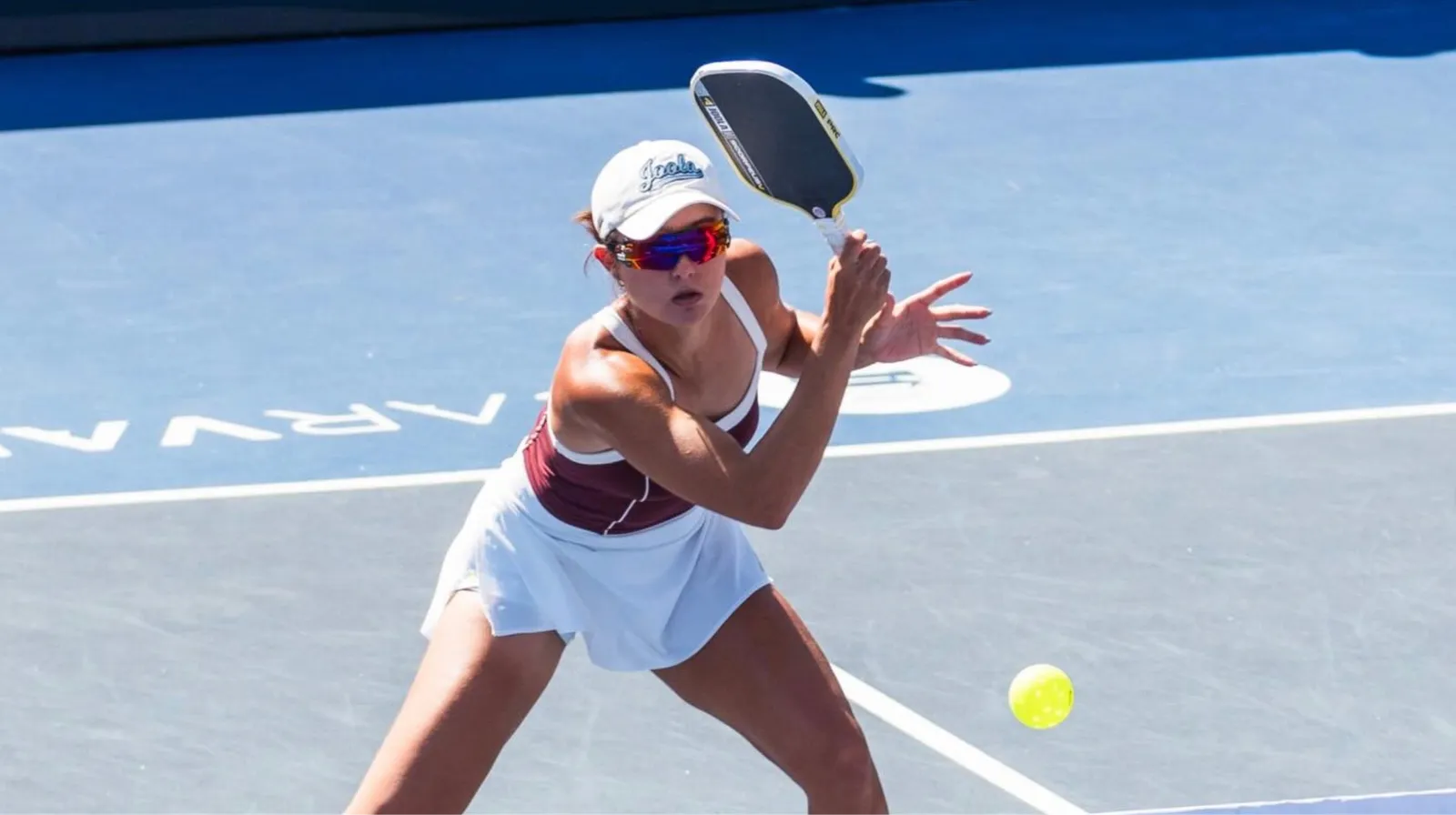
Same court, same ball, same 11 points. Recreational and professional pickleball run on identical rules. However, both are two completely different games. Shot selection, court positioning, and when a rally slows down are different for rec players and pros.
So, how is a typical pickleball session different from the pros? What are strategies that you can try to adapt to win your rec games?
The Rules Are Identical, The Game Is Not
The rules are the same in both rec and pro play. The serve must go underhand and below the waist. The two-bounce rule still applies to every rally, and stepping into the kitchen to volley loses the point at every level.
What changes is how players use those rules. Recreational players treat the kitchen line as a place they visit. Professionals treat it as the only place worth standing. That single difference reshapes the entire rally structure.
For example, consider a standard rally where Player A (at the baseline) plays a soft drop shot toward Player B's kitchen line. For pros, the moment Player A makes contact with the drop shot, they immediately sprint directly to the kitchen line before the ball even crosses the net.
As a result, Player B hits the exact same aggressive reply. However, because Player A is already established shoulder-to-shoulder at the non-volley zone line, they intercept the ball at chest height with a compact dink. By claiming the line, Player A completely neutralizes Player B’s attack and resets the rally into an even kitchen-dinking battle.
A rec point often ends before anyone reaches the net. A pro point often does not begin properly until all four players arrive there.
Where Each Level Spends the Rally?
The rally is the central battleground where virtually all scoring and tactical strategy occur. Recreational players treat a rally as a sequence of individual reactions, while professionals view it as a deliberate construction of court geometry.
A typical rec rally features rapid swings between soft play and hard drives, often ending within 3–6 shots because someone takes an unnecessary high-risk swing at a low ball. Meanwhile, a pro rally follows a strict hierarchy:
- Transition smoothly from baseline to kitchen
- Engage in high-density dinking to probe for weaknesses
- Speed up only on balls above the net
- Finish with rapid hand-speed volleys.
Let's take a look at where each phase of a rally is for both rec and pro players:
Rally phase | Recreational play | Professional play |
Serve and return | Return lands mid-court, returner stays back | Return lands deep, returner sprints to the kitchen |
Third shot | Hard drive at the nearest body | Drop into the kitchen, or a drive designed to set up the fifth |
Transition zone | Players linger and get caught mid-court | Players cross it fast or split-step and reset |
Kitchen exchange | Short, ends in 2 to 4 shots | Extended, often 15 shots or more |
Point ends on | An unforced error | A forced error or a won hands battle |
That final row carries most of the weight. Recreational points end because someone makes a mistake. Professional points end because someone creates a mistake.
The practical takeaway is simple. Winning more rec games rarely requires better shots. It requires fewer free points handed over.
Skill Gap Between Pro and Rec Play
While pro and rec players use the same court, rules, and equipment, mechanical execution, spatial awareness, and decision-making operate at different levels.
The Power and Speed-Up Dynamic
Rec players often treat speed-ups as a default tool for scoring points. They attempt to hit hard, winning shots off low-bouncing balls. They frequently swing from below net level, which either hits the net or pops up into an easy counter-attack for the opponent.
Meanwhile, pros treat speed-ups as a calculated risk requiring strict qualification. They only attack when the ball bounces high enough to strike downward or across a shallow angle. Off low balls, they patiently dink to reset the exchange, holding power in reserve until the defense pops up a vulnerable ball above net level.
Transition-Zone Defense and Resets
When caught moving from the baseline to the non-volley zone, rec players struggle under incoming pressure. If an opponent drives a ball at their feet mid-court, they tend to panic. They either taking a full swinging stroke or pop the ball high into the air.
Pros possess elite reset mechanics. When hit at in the transition zone, they immediately drop their body weight, soften their grip, and use a compact, paddle-absorbing block to deaden the ball gently into the opponent’s kitchen, instantly restoring dynamic equality.
Footwork & Spatial Anchor
Rec footwork is often reactive and inefficient. Players frequently shift weight while striking the ball, take unnecessary extra steps, or drift away from the non-volley line after hitting a shot out of fear of getting hit.
On the other hand, pro footwork is rooted in balance and spatial economy. They arrive at their position before the shot is made, wide-based and motionless at contact. They treat the non-volley zone line like a physical wall. They hold their ground, leaning into the court, and refusing to yield inch of depth.
Paddle Readiness & Defense
Rec players frequently drop their paddle down to waist or hip level between shots while watching their own hit, leaving them vulnerable to fast reflex exchanges.
Meanwhile, pros maintain strict paddle discipline. Between every shot, the paddle returns immediately to a high, neutral chest-height ready position ("paddle up"), allowing them to counter 80–90 mph reaction-time speed-ups in fractions of a second.
Pace, Scoring, and Match Format
Recreational sessions usually run traditional side-out scoring. Only the serving team scores. Games go to 11 and you win by 2.
Professional events mix formats. Singles and doubles on the PPA Tour run best-of-three or best-of-five games depending on the round. Major League Pickleball uses rally scoring, where every rally produces a point, which compresses matches and rewards consistency under pressure.
Rally scoring punishes cold starts. Under side-out scoring, you can lose six rallies and still trail 0-0 on the scoreboard. Under rally scoring, you are down 6-0.
If you plan to enter tournaments, check the format before you register. It changes how you should warm up and how much a slow first game costs you.
You Are Not Failing at Pro Pickleball
Professional pickleball is a specialised format optimised for elite athletes playing multiple matches per day under broadcast conditions. It is not the correct model for a 4-hour Saturday session with mixed partners on a hot outdoor court.
Pros run Erne attacks, around-the-post winners, and two-handed backhand flicks off the bounce. Those shots exist because pros have removed every simpler option from their opponents. You still have simpler options available. Use them.
Copying advanced patterns before the fundamentals hold is the single most common reason intermediate players stall.
What This Looks Like on Malaysian Courts
Weekly sessions at KL and Selangor venues now regularly mix 3.0 players with 4.5 players on the same court. That mixing accelerates learning and creates one specific problem. Newer players watch a stronger partner speed up a ball successfully, then copy the speed-up from a worse position and lose four straight points.
Venues in Penang, Johor Bahru, and the Klang Valley increasingly split courts by DUPR band for that reason. Play the rated session if your venue offers one. Consistent opposition teaches shot selection faster than mixed-level chaos.
Ready to close the gap with structured help? Browse rated coaches across Malaysia at coach.thepicklebase.com and follow @thepicklebase for drills and match breakdowns.
Common questions
What DUPR rating counts as professional?
Touring professionals generally sit above 6.5, with the top men's doubles field clustered near 7.0 and above. Most recreational players live between 2.5 and 4.0. A 4.5 player is strong at almost any local venue and still far from tour level.
Do pros hit the ball harder than recreational players?
Not always, and often less. Pros hit harder when the situation rewards it and far softer the rest of the time. We unpack that in why recreational players hit harder than pros.
Should I watch pro matches to improve?
Yes, but watch the players without the ball. Track their feet and their court position between shots rather than following the ball. That is where the lesson sits.
How long does it take to move from 3.0 to 4.0?
Most players need 6 to 12 months of consistent play plus deliberate practice on the soft game. Playing more games alone rarely does it.