
A fault in pickleball is a rule violation that immediately stops play and ends the rally. When a fault occurs, the team that committed it forfeits the rally. This results in either a point for the opposing team or a loss of a serve (side-out).
This is important because it directly impacts your match strategy, prevents unforced points, and allows you to play aggressively without breaking rules.
Line and Boundary Rules
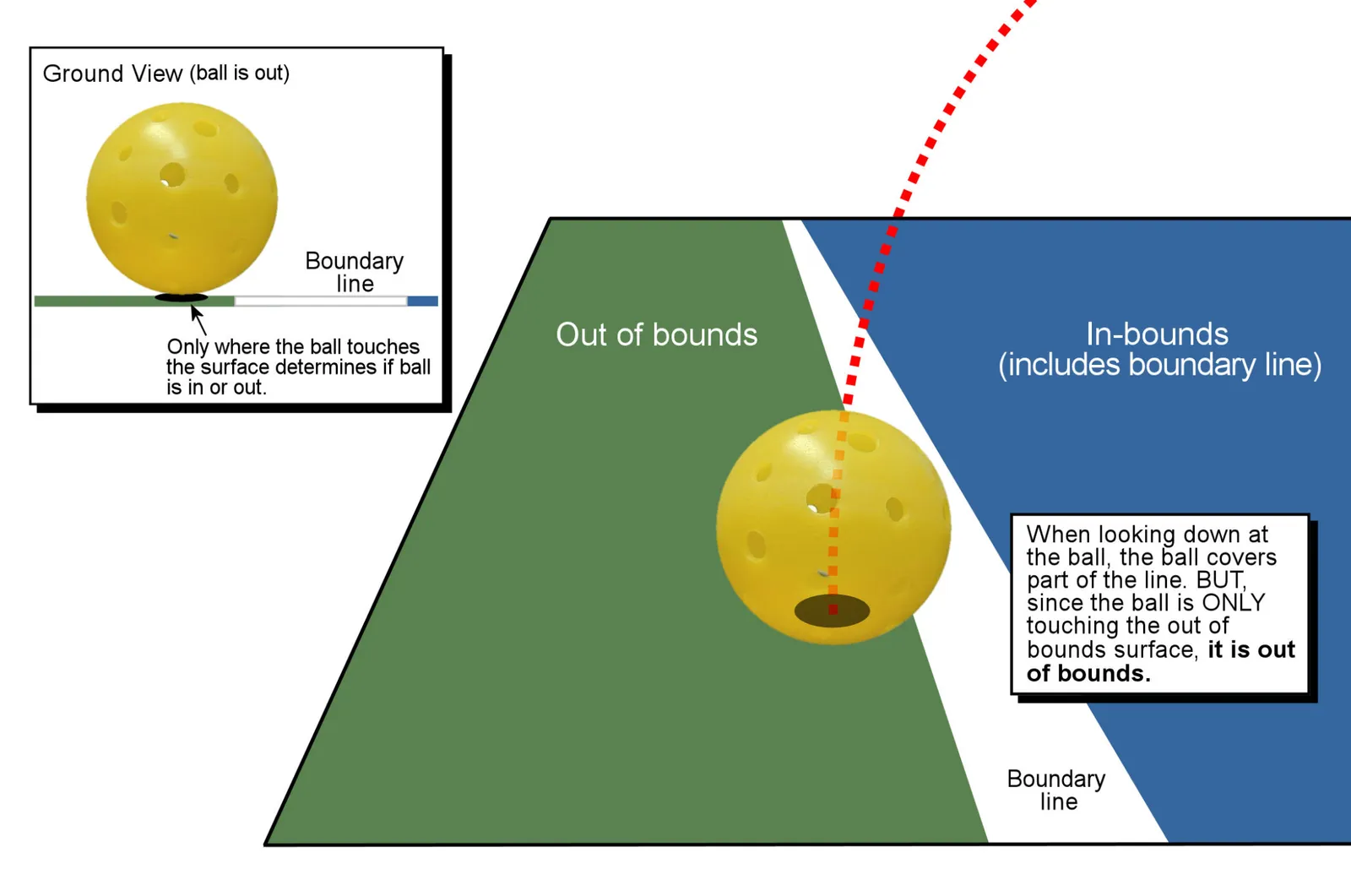
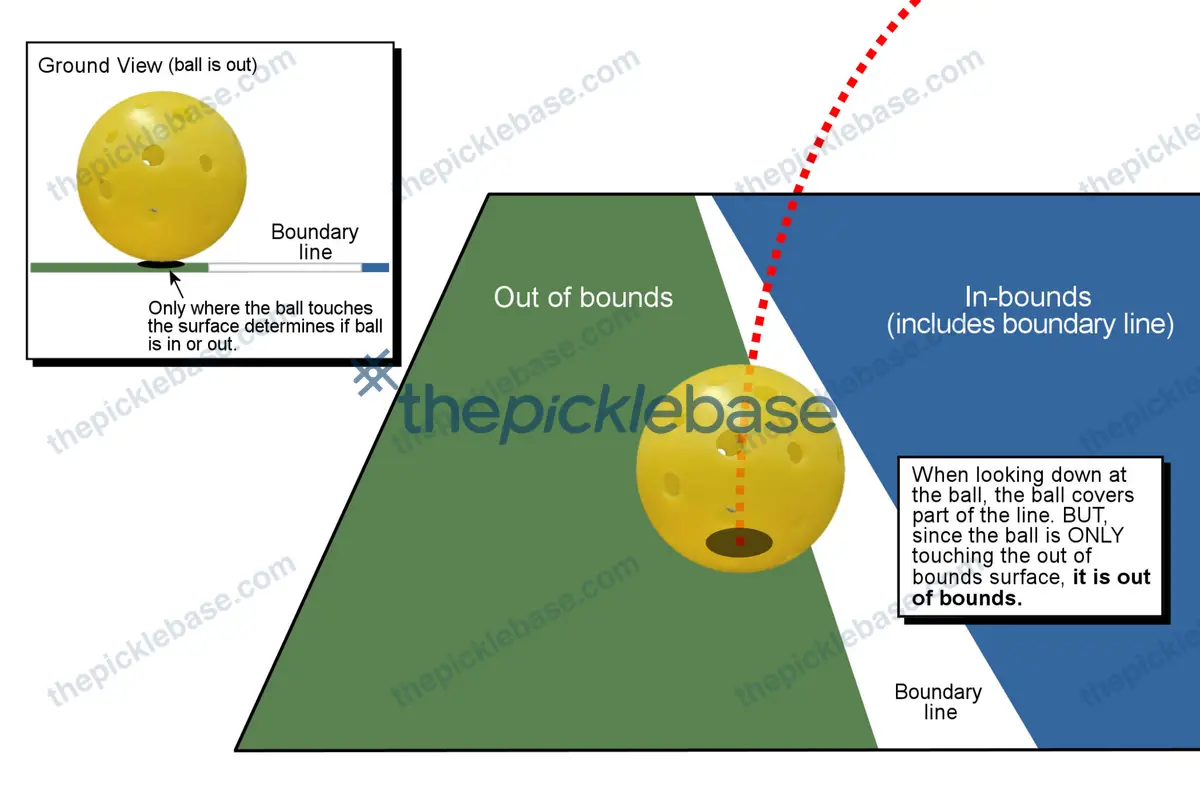
Line and boundary rules in pickleball determine whether a shot is legal based on where the ball makes contact with the court surface and where a player stands.
- The "Line Is In" Rule: On standard play and serve returns, any ball landing on a court line is considered in.
- The Kitchen Line Exception: The Non-Volley Zone (Kitchen) line is considered out for serves. If a served ball clips the Kitchen line, it is a serve fault.
- Ground Contact: A ball is only out if its contact point with the court surface is completely outside the line.
Key Ball In vs. Out Scenarios
Scenario | Ruling | Reason |
Ball lands on the baseline/sideline during a rally | IN | Outer boundary lines are part of the active court area. |
Serve hits the Kitchen line or inside the Kitchen | OUT (Fault) | The serve must clear the Kitchen and its line entirely. |
Serve hits the diagonal court baseline, sideline, or centerline | IN | All outer bounds of the receiving box are in-bounds for serve. |
Ball is hit overhead and lands outside the line, but its shadow is on the line | OUT | Line calls rely strictly on physical surface contact, not shadows or visual overlap. |
Live ball hits a player standing outside the court lines | IN (Fault on player) | If a live ball touches a player or their clothing before bouncing, it is a fault on that player regardless of where they are standing. |
Non-volley (Kitchen) Zone Rules
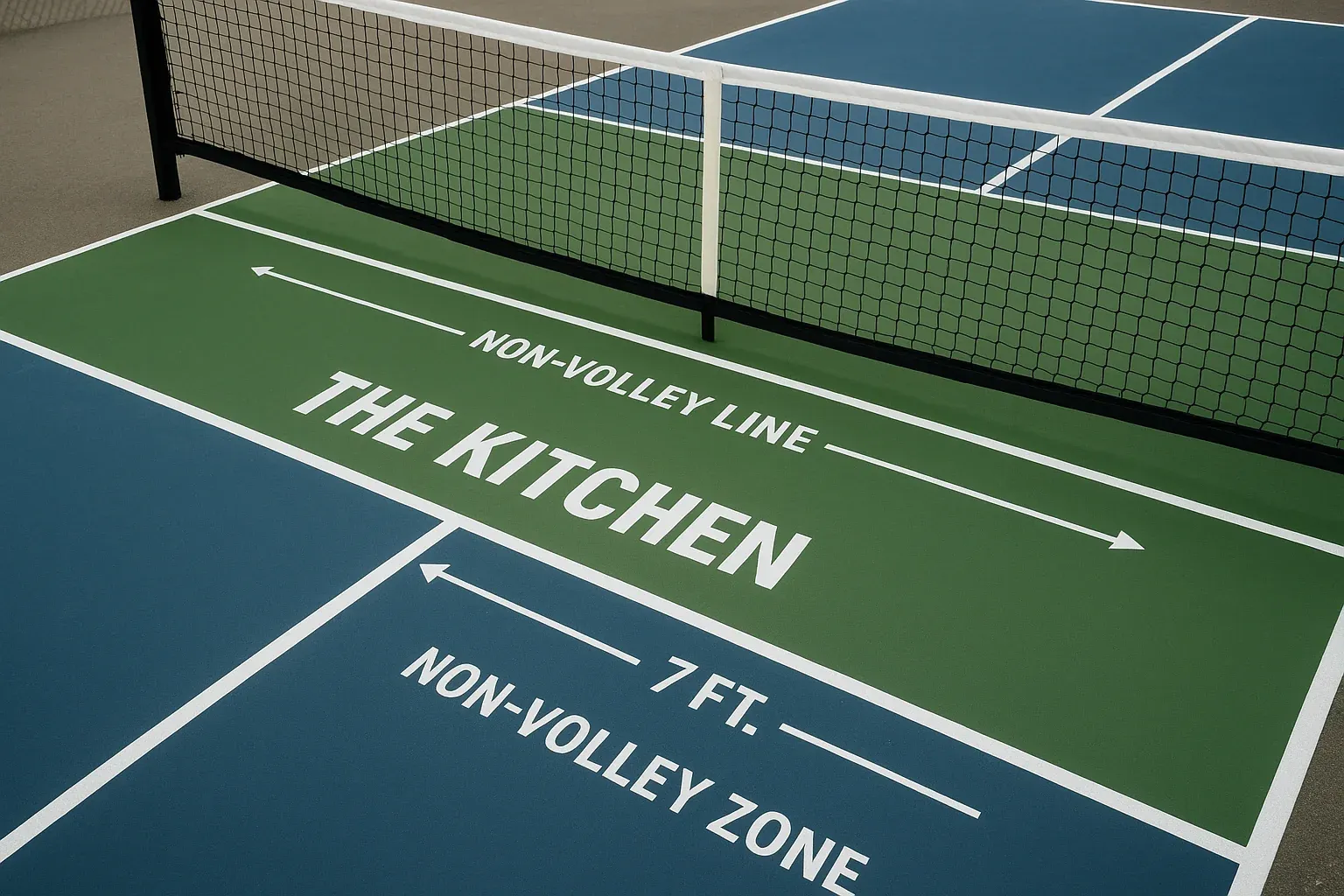
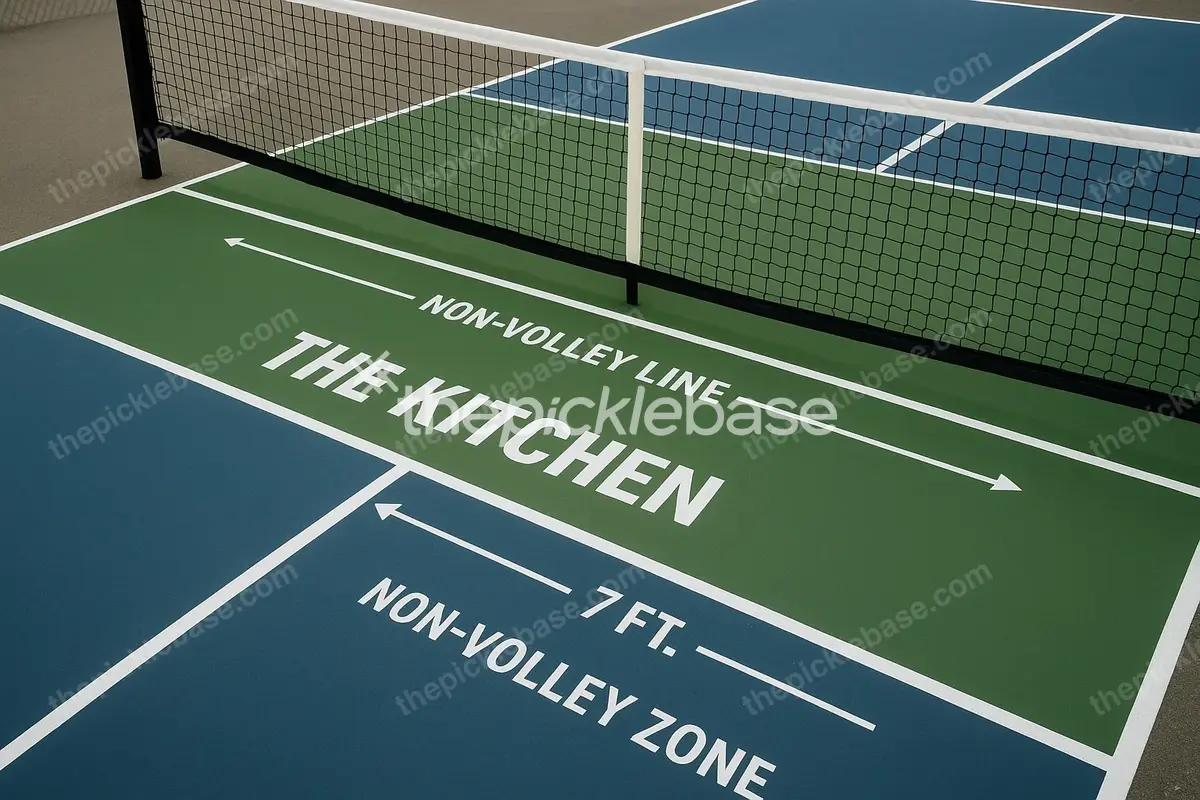
The Non-Volley Zone (NVZ) (commonly called the "Kitchen") is the 7-foot by 20-foot rectangular area on both sides of the net.
- Volleying inside the Kitchen: If you hit a ball out of the air before it bounces, your feet (and any part of your body, paddle, or clothing) must be completely behind the Kitchen line.
- The Line is Part of the Zone: The 2-inch Kitchen line itself is considered part of the Non-Volley Zone. Stepping on, touching, or having your foot overhang and touch the line while volleying is a fault.
- Bounced Balls are Fair Game: You can stand inside the Kitchen to hit a ball, as long as the ball has bounced first. There is no rule against being in the Kitchen but only against volleying from inside it.
You can read more about rules in the kitchen in our guide: What is the Non-Volley Zone?
The Momentum Rule
Momentum faults are the most frequently missed or misunderstood violations in casual play:
- Continued Action: If your momentum from hitting a volley carries you, your feet, your paddle, your hat, or any personal item into the Kitchen (or onto the line), it is an immediate fault.
- Dead Ball Exemption Does Not Exist: Even if your shot lands completely out of bounds or hits the ground on the opponent's side before you step into the Kitchen, it is still a fault. The momentum from the volley must be fully stopped before any part of you touches the Non-Volley Zone.
- Re-establishing Position: If you were standing inside the Kitchen and an attack shot comes at you, both feet must touch the court surface outside/behind the Kitchen line before you can legally hit a volley.
Common Misconceptions vs. Actual Rules
Misconception | Actual Rule |
"You can't stand in the Kitchen." | False. You can stand, move, and hit bounced balls inside the Kitchen at any time. |
"If the ball hits the ground first on their side, my momentum fault doesn't count." | False. Momentum rules apply until your balance and forward movement are completely stopped. |
"Your paddle can't cross over the Kitchen line." | False. Your paddle can swing through the air space above the Kitchen, as long as neither you nor your paddle touches the ground/line inside the zone. |
"If your partner holds you back, it's legal." | True. Your partner may physically hold you or pull you back to keep your momentum from crossing the line, provided they are standing outside the Kitchen. |
Service and Motion Rules
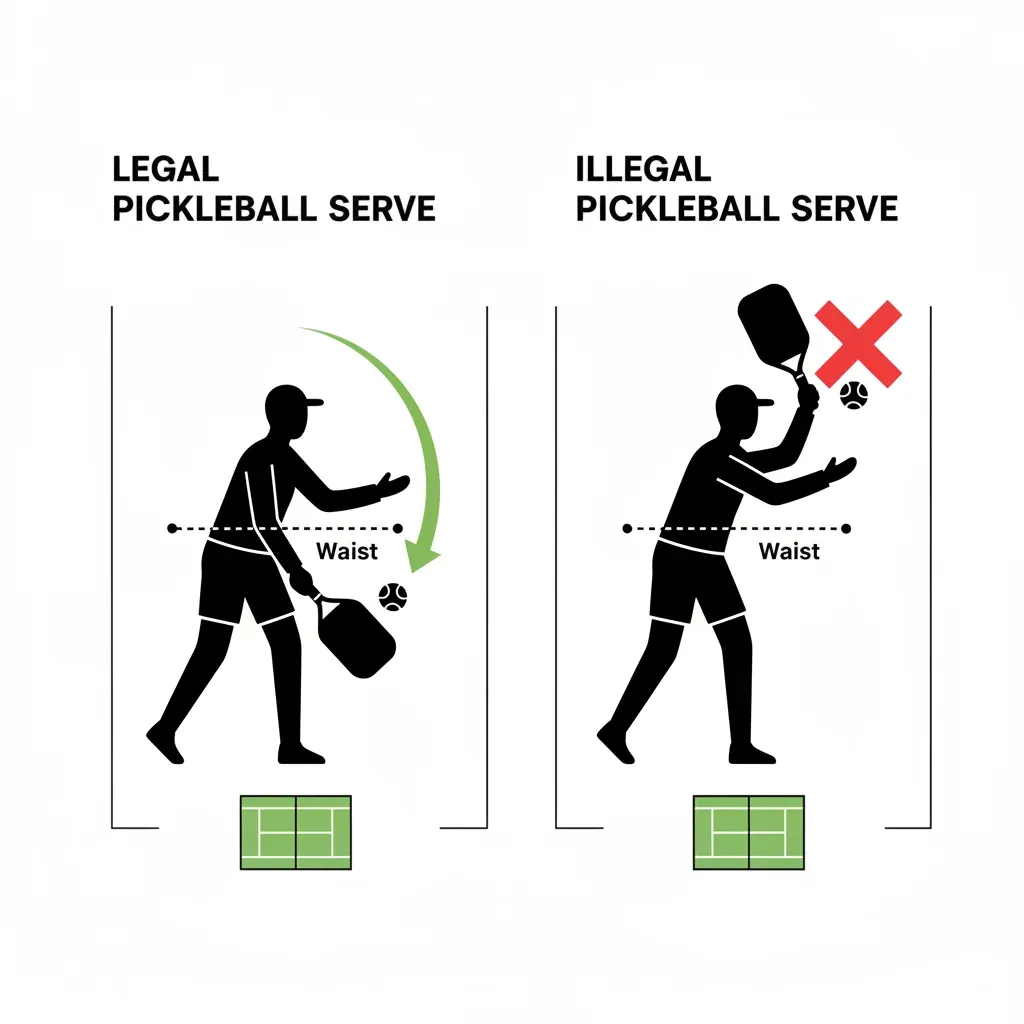
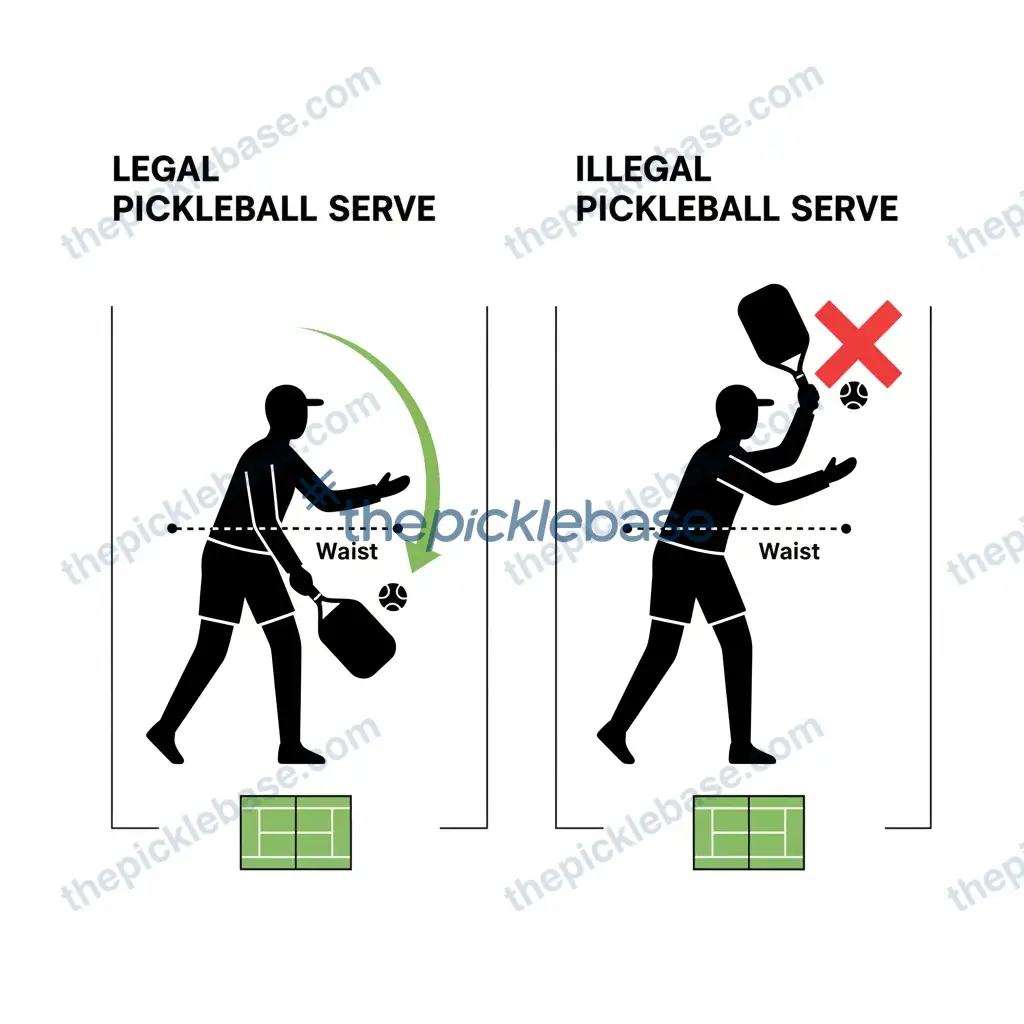
Pickleball service and motion rules govern how a rally is initiated. It ensures that serves remain defensive or neutral rather than overhand attack shots. Check out our guide on how to serve legally.
Volley Serve Rules (Hitting out of the air)
When striking the ball directly out of the air on a serve, you must follow three strict mechanical requirements at the point of paddle contact:
- Upward Arc: The server's arm must move in an upward arc at the moment of impact.
- Below the Waist: Contact with the ball must be made strictly below the waist (defined as the level of the navel).
- Paddle Head Position: The highest point of the paddle head cannot be above the highest part of the wrist (where the wrist joint bends).
Drop Serve Rules (Bouncing before hitting)
As an alternative, players can use a drop serve by letting the ball drop to the court and bounce before hitting it.
- No Height or Motion Restrictions: The upward motion, paddle head below wrist, and below-waist rules do not apply to a drop serve.
- Natural Release: You must drop the ball from any height using your hand or paddle. You cannot throw, bounce, or push the ball downward into the court surface.
Feet & Positioning Faults
Regardless of serve style, feet positioning rules apply until paddle-ball contact occurs:
- Baseline Rule: At least one foot must be touching the ground behind the baseline. Neither foot may touch the baseline or the court inside.
- Lateral Boundaries: Neither foot may touch the ground on or outside the imaginary extensions of the sideline or centerline.
Illegal Spins & Manipulations
- The "Chainsaw" Ban: You cannot spin the ball with your non-paddle hand before releasing it for the serve.
- Bare Hand Drop/Toss: The ball must be released visibly using only your bare hand or dropped off the paddle face without imparting artificial spin.
Gameplay Interruptions
General gameplay faults encompass violations that occur during active rallies outside of basic service or kitchen footwork errors. Understanding these rules ensures fair rally play and prevents accidental point forfeits.
- Out of bounds: Hitting the ball so it lands entirely outside the court lines. (Note: Lines are considered "in," except for the Kitchen line on a serve).
- Double bounce rule violation: Failing to let the ball bounce once on the serve return and once on the third shot before volleying.
- Net touches: Touching the net, net posts, or opponent’s court side with your body, clothing, or paddle while the ball is live.
- Double hit: Intentionally hitting the ball twice or dragging it on the paddle face (a single continuous accidental double-hit is legal).
- Ball touches player: The live ball hitting a player's body or clothing before bouncing.
What Happens When You Commit a Fault?
When a player or team commits a fault, the live ball immediately becomes dead, and the active rally ends instantly. The specific consequence depends on whether the match uses traditional side-out scoring or rally scoring, as well as which team committed the fault.
Here's how the sequence plays out:
- Play Stops: Players must stop hitting the ball immediately. Any shots taken after the fault occurs are void and carry no official standing.
- Score Call: Before the next point begins, the server must call the score fully (Server Score - Receiver Score - Server Number in traditional doubles) once both teams are set.
- No Retries: Unlike tennis (where a missed first serve gives you a second serve), pickleball gives you only one attempt per serve. A service fault results in an immediate loss of serve or point.
Standard Side-Out Scoring (Most Common)
In standard pickleball scoring, only the serving team can score points.
If the Serving Team Commits a Fault | If the Receiving Team Commits a Fault |
First Server (Server 1): In doubles, if Server 1 commits a fault, no point is awarded to the opponents. Serve transitions to the second server on the same team (Server 2). Second Server (Server 2) / Singles: If Server 2 (or a singles server) commits a fault, it results in a side-out. The serving team loses the serve, and the opposing team gains the serve. | The serving team earns 1 point. The server rotates to the opposite side of their court to deliver the next serve. |
Rally Scoring (Alternative Format)
In rally scoring (often used in professional leagues or fast-paced club play), every single rally results in a point, regardless of who served.
If the Serving Team Commits a Fault | If the Receiving Team Commits a Fault |
The receiving team earns 1 point and gains the serve (a side-out). | The serving team earns 1 point and retains the serve. |
Our scoring rules guide breaks down exactly how points and serve changes work together across a full game.
Common Questions
Does every fault end in a point being scored?
A point is only scored when the serving side wins the rally. If the serving side faults, the serve simply passes on with no point awarded to anyone.
Can a fault happen without anyone touching the ball?
Stepping into the kitchen too early, serving from the wrong position, or serving out of turn are all faults that can happen without a bad shot ever being hit.
Is stepping on the baseline during a serve always a fault?
Yes, if it happens before paddle contact. Once the ball has been struck, the server is free to step wherever they need to for the next shot.
What is the difference between a fault and a let?
A fault ends the rally and has a scoring consequence. A let, such as a serve that clips the net and still lands legally, simply means play continues as normal with no penalty at all.