

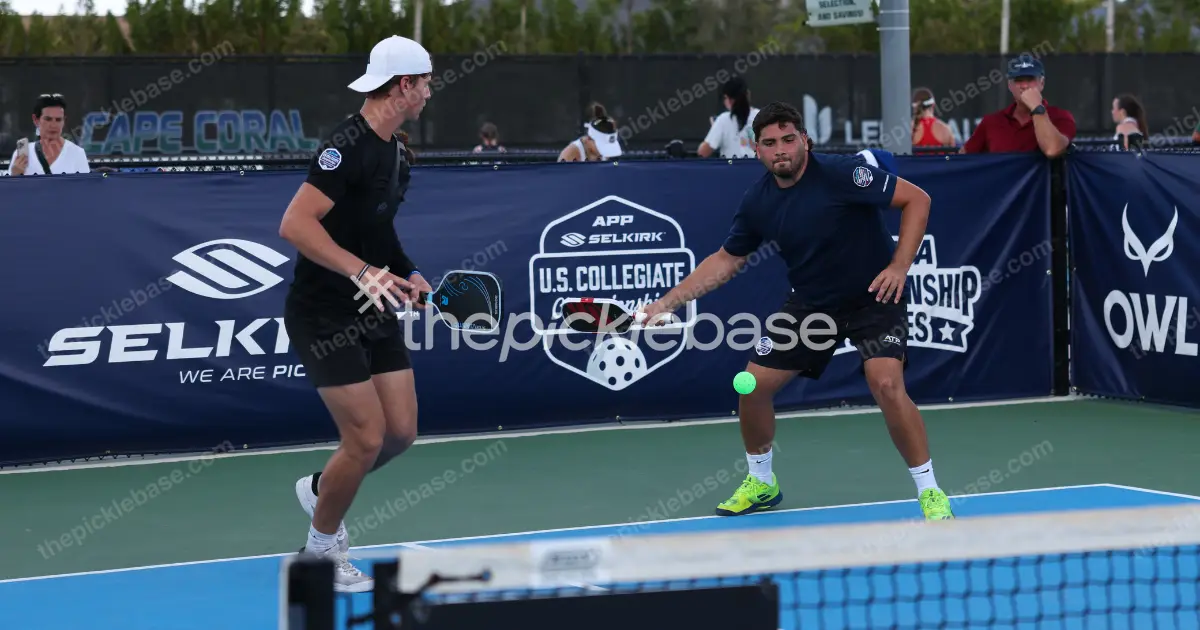
Most of us learn to play pickleball through doubles. This is the most common way to play at rec centers and community courts and is what makes pickleball such a social sport. However, when you play Singles, there are changes to how you play the sport.
In Doubles, you are focused on kitchen-line control, dinking patience, and targeted communication between partners. On the other hand, Singles forces you to cover the full width of the court, making stamina, deep drives, and baseline-to-kitchen transitions critical.
Let's put those rules side by side so you know the rules as you transition from one format to the other.
Score Calling
Score calling in pickleball communicates three vital pieces of information:
- Who is serving
- Who is winning
- Who gets to serve next
Because singles has no partners, its call is stripped down to two numbers, while doubles requires three numbers to manage the two-server rotation.
Singles Score Calling (2-Digit Format)
Because there is only one server, there is no server number in Singles. In Singles, the score is called [Server Score] – [Receiver Score]. If the server loses the rally, a "side-out" occurs where serving rights are officially transferred from one team (or player) to the opposing team.
In singles, your score dictates which side of the court you serve from:
- Even score (0, 2, 4, 6...): You serve from the Right service court.
- Odd score (1, 3, 5, 7...): You serve from the Left service court.
For example, you have 3 points, and your opponent has 2. You call "3-2" and serve from the left court (because 3 is odd). If you win the rally, your score becomes 4, so you call "4-2" and switch to serve from the right court.
Doubles Score Calling (3-Digit Format)
In doubles, the score is called as [Serving Team Score] – [Receiving Team Score] – [Server Number (1 or 2)].
Every serve turn (except the very start of the game) grants both partners a turn to serve. The player who starts the serving rotation is "Server 1." When Server 1 loses a rally, the team doesn't lose the serve. Instead, it passes to partner "Server 2." Only when Server 2 loses a rally does a side-out occur.
The "First Game Exception": To prevent the starting serving team from having an unfair advantage, the team that serves first at the start of a match only gets one server turn. Therefore, the very first call of the entire game is always "0-0-2". |
Our scoring rules guide walks you through the full three-number system with examples if you want it explained step by step.
Serving Rights
Serving rights (or how a side earns, retains, and loses the right to serve) are fundamentally structured around player capacity.
In traditional side-out scoring, you can only score points while holding serving rights. The moment your serving privileges end, a side-out occurs, and the ball goes to your opponent.
Serving Right Rule | Singles | Doubles |
Fault Tolerance | 1 Fault per side-out | 2 Faults per side-out (1 per partner) |
Game-Start Privilege | Standard 1-fault rule applies from point 0 | "First Server Exception": Only 1 fault allowed on the very first turn |
Partner Hand-off | None (Immediate side-out) | Service hands off to Partner 2 after Partner 1 faults |
Court Side Control | Server score determines court side for both server and receiver | Server position is fixed by where the partner was standing when rights were gained |
Our serving rules guide covers the full mechanics of a legal serve, and every rule in it applies equally to singles and doubles.
Singles (Direct Binary Transfer)
In singles, serving rights are held exclusively by a single individual. As long as you win rallies, you retain serving rights and alternate between the right and left courts.
The moment you commit a fault, your serving rights end instantly. Serving rights pass directly across the net to your opponent, who serves from the side matching their own score parity (even = right, odd = left), as we explained earlier.
Doubles (Two-Tier Team Transfer)
In doubles, serving rights belong to the team and not just one player. Here's how you serve in Doubles:
- Server 1: Begins serving from the side where they were standing when the side-out occurred. If Server 1 wins rallies, they switch sides with their partner to continue serving.
- Hand-off to Server 2: When Server 1 loses a rally, the team does not lose serving rights. Serving rights shift to Server 2, who serves from wherever they are currently standing. Unlike Singles, there is no side-switch on a fault.
- Side-Out: Only when Server 2 loses a rally are the team's serving rights exhausted, resulting in a side-out.
Positioning Strategies
Aside from positioning during serves, Singles vs Doubles also have different positioning strategies. Singles players must cover the entire court alone, meanwhile Doubles players need to lock down the net as a unit.
In singles, you have to defend 440 square feet solo. There is no partner to coordinate with, no communication needed on who takes a shot, and no gaps to cover for a teammate. Positioning is entirely about bisecting the opponent's available angles.
Doubles positioning is team-based. This means both players move together, cover different zones, and communicate on every shot near the middle of the court. A well-positioned doubles team stands roughly level with each other near the non-volley zone, closing off the middle and the lines at the same time.
Obviously, there are plenty more strategies that are unique to both formats. We've only covered the basics to help you understand your positioning on court when you play Singles or Doubles.
Third-shot Play
Third-shot play refers to the stroke hit by the serving team on their second touch of a rally. Because of pickleball's Two-Bounce Rule, the serve (shot 1) and return (shot 2) must both bounce before anyone can hit a volley out of the air. This makes the third shot the pivotal moment where a point's tactical structure is set.
From an official rulebook standpoint, the third-shot rule is identical in both singles and doubles. The server (or serving team) must let the returned ball bounce once before hitting it.
However, because of court geometry and player coverage, the tactical execution of the third shot completely diverges between the two formats.
Third-Shot Drive Priority in Singles
In singles, your opponent is covering 20 feet of court width entirely by themselves (just like you). A single opponent running forward from the baseline after returning your serve cannot guard both sideline angles simultaneously.
The objective is to hit a flat, fast third-shot drive down the line or into the deep opposite corner. This can catch your opponent and either catch them mid-stride or force a weak pop-up. You can take this opportunity to transition forward or win the point outright without needing a delicate kitchen drop.
Third-Shot Drop Priority in Doubles
In doubles, the receiver's partner starts at the kitchen line and sprints up after returning the serve. Driving a hard ball at two players established at the kitchen line usually results in them blocking it straight at your feet while you're stuck at the baseline.
The goal is to hit an unattackable, arcing drop shot that lands softly inside the opponent's kitchen. This forces your opponents to hit upward, allowing you and your partner to transition from the baseline up to the kitchen line together and equalize the point.
Learning to Play Singles vs Doubles
Singles tests individual endurance and drive placement. Meanwhile, doubles tests rotation tracking, stacking strategy, and kitchen-line synchronization. While both formats follow the same foundational rules, mastering their distinct scoring calls and positioning dynamics is essential for competitive play.
Whether you are honing your solo court coverage or mastering team stacking, targeted instruction accelerates your progress. You can work with accredited coaches to help you break down rules and strategies to improve play.
Common Questions
Is the non-volley zone bigger in doubles?
No. The non-volley zone, along with every other part of the court, stays the same size in both singles and doubles.
Can two people play singles rules on a doubles court?
No. Singles and doubles use the same physical court, so there is no separate singles court to switch to. Only the rules and positioning change.
Which format is better for beginners to learn first?
Neither format is objectively easier to learn, though doubles tends to be more forgiving physically since court coverage is shared between two players.
Do singles players need to know the three-number scoring system?
No. Singles only uses two numbers, since there is always just one server per side. The third number only exists to track which doubles partner is serving.
Once you have singles and doubles rules straight, the master beginner guide for the week ties every piece together, from the serve to your first full game.