
Although a serve starts the game in a pickleball rally, what happens after decides who gets to attack the net first. However, the serving team doesn't automatically assume an attack position. After a serve, a two-bounce rule (officially called the Double-Bounce Rule by the USA Pickleball Rulebook) is observed by all players. It requires that the ball bounce once on each side of the court before either team is allowed to hit a volley out of the air.
Without this rule, the serving team could immediately rush the net and smash the return out of the air, giving them an overwhelming competitive advantage. Requiring two bounces levels the playing field by allowing the receiving team time to hit a deep return and advance to the kitchen line before the serving team can start volleying.
How the Two-Bounce Rule Works
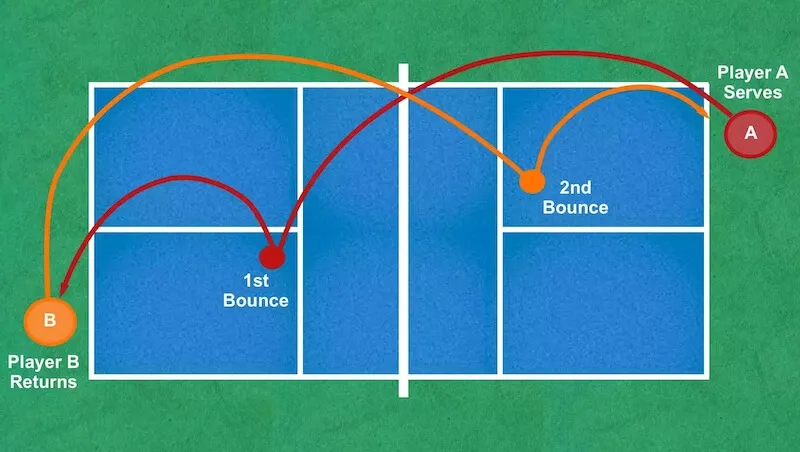
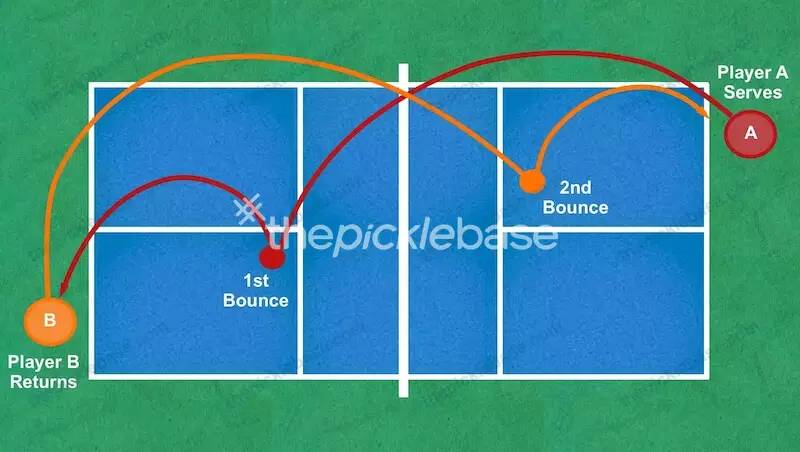
Image courtesy of Pickleball Play Guide
The sequence always plays out the same way, no matter who is serving. Here is the order of events:
- Bounce 1 (The Serve): The serving team hits the serve over the net. The receiving team must let the ball bounce once before returning it.
- Bounce 2 (The Return): The receiving team returns the shot. The serving team must let the ball bounce once before hitting it back.
- Open Play: Once those first two bounces have occurred, both teams can either volley the ball (hit it out of the air) or play it off a bounce.
If you miss a required bounce anywhere in that sequence, it counts as a fault, even if the shot would have been a perfectly clean volley in a later part of the rally.
Our serving rules guide covers everything that happens before this sequence starts, including where the server stands and what makes a serve legal.
Two-Bounce Rule vs Kitchen Rule: These two rules control two different things. The two-bounce rule determines when players are allowed to start volleying after the serve and return. Meanwhile, the kitchen rule determines where on the court players are allowed to volley from, no matter what point in the rally it is. You could be well past the two-bounce sequence and still commit a fault by volleying while standing inside the non-volley zone. The two rules work together, but they answer different questions. Read our kitchen guide for the full breakdown of where the non-volley zone starts and ends. |
New players often mix up the two-bounce rule and the kitchen rule, even though they control two completely different things. The two-bounce rule determines when players are allowed to start volleying after the serve and return. The kitchen rule determines where on the court players are allowed to volley from, no matter what point in the rally it is.
You could be well past the two-bounce sequence and still commit a fault by volleying while standing inside the non-volley zone. The two rules work together, but they answer different questions. Read our kitchen guide for the full breakdown of where the non-volley zone starts and ends.
What Happens After the Two Bounces?
A common misunderstanding is that the ball must bounce twice on every single shot for the rest of the point. The reality is, the two-bounce requirement only covers the serve and the very next return. After the ball has bounced once on each side, any player can choose to volley the ball out of the air or wait for it to bounce again.
This is exactly why players race to get to the non-volley zone line once the two bounces are done. Being able to volley opens up faster, more aggressive shots that simply are not available during the opening two bounces.
Does the Two-Bounce Rule Apply to Singles?
The two-bounce rule works the same way in singles as it does in doubles. The server serves, the receiver lets it bounce and returns it, the server lets that return bounce and hits it back, and only then can either player volley.
What changes between singles and doubles is not the two-bounce rule itself, but the scoring and serving rotation around it. Singles has one server at a time, while doubles usually gives each team two servers per turn. The two-bounce sequence plays out the same regardless of which format you are on.
Strategic Impact of the Two-Bounce Rule
The two-bounce rule is foundational to pickleball's design. It directly shapes how rallies are constructed and balancing court advantage between opponents.
- Prevents Serve-and-Volley Dominance: In sports like tennis, a player can serve and immediately charge the net to volley away a weak return. In pickleball, forcing the serving team to wait for the bounce keeps them pinned near the baseline for their first hit.
- Levels the Playing Field: The receiving team actually holds the positional advantage early on. Because the receiver hits their shot on the move, they can hit deep and run straight up to the Non-Volley Zone (kitchen line) while the serving team is forced to stay back.
- Extends Rallies: By prohibiting instant smashes off the return, the rule guarantees that almost every point develops past the serve. This produces longer, more tactical exchanges rather than quick one-shot points.
- Creates the "3rd Shot" Paradigm: Because the serving team is stuck at the baseline while the receiving team controls the net line, the serving team must hit a delicate, soft shot (a 3rd shot drop or drive) to earn their way forward safely.
Effects on Player Positioning
Because of the two-bounce rule, the receiving team gets the first opportunity to take control of the net:
Team | Opening Position | Strategic Objective |
Receiving Team | At the kitchen line (controlling the net) | Keep the serving team pinned back; look for high bounces to attack first. |
Serving Team | At the baseline (defensive position) | Neutralize the point with a drop or drop-drive sequence to earn their way up to the net. |
An attack from the baseline rarely wins a point against a well-positioned team at the kitchen. Therefore, "attacking first" is about reaching the kitchen line first so you can attack from an advantageous angle.
Because the receiver hits their shot on the move, they can hit a deep return and immediately run up to hold the kitchen line. If the server hits a weak third shot, the receiver is already positioned at the net to crash forward and attack out of the air.
Since the servers are pinned near the baseline for their first hit, attacking directly from 22 feet away is high-risk. A hard drive from the baseline travels upward over the net, giving the net-positioned receivers an easy ball to smash back down.
Because of this rule, the serving team cannot simply attack immediately. They must first neutralize the point with a soft drop shot to earn their way up to the kitchen line before they can safely launch an attack of their own.
Common Mistakes with the Two-Bounce Rule
Mistakes from the Two-bounce rule are not because players don't understand the rule but because of habits and muscle memory from other racquet sports:
- Volleying the Return of Serve (Shot 2): The server hits a great serve, watches the opponent return it, and instinctively steps up to hit the incoming ball out of the air. Because the ball hasn't bounced on the server's side yet, this immediately loses the point.
- Charging the Net Immediately After Serving: A classic tennis habit where the server serves and immediately runs forward to the kitchen line. This leaves them completely out of position when the return lands at their feet, forcing an illegal volley or an impossible awkward bounce hit.
- Stepping Into the Kitchen on the Return (Shot 2): Receivers often stand too close to or inside the kitchen line while waiting for the serve. If the serve comes in deep or fast, they get caught awkwardly trying to let it bounce while backing up.
- Mistaking It for a "Double Bounce" Fault: New players often confuse the two-bounce rule (one bounce on each side during the opening sequence) with letting the ball bounce twice on the same side (which is always a fault/dead ball).
- Forgetting Who Must Let It Bounce: In doubles, the server's partner sometimes forgets they are also bound by the rule. If the return comes toward the server's partner, they cannot poach it out of the air.
Practice always makes perfect. If you want to improve and push your skills as a pickleball player, you can book your a personal coaching session with accredited pickleball coaches in the region.
Common Questions
Can the serving team volley the return of serve?
No. The serving side must let the return of serve bounce once before hitting it, even if the ball comes back short and looks easy to smash out of the air.
Does the two-bounce rule apply after a let serve?
Yes. A serve that clips the net and lands legally in the correct service court still triggers the same two-bounce sequence as any other serve.
What happens if I volley too early by mistake?
Volleying before the required bounce is a fault, which ends the rally immediately and hands the point or the serve to the other side, depending on who was serving.
Is the two-bounce rule the same in every format of pickleball?
The core sequence stays the same across singles, doubles, and mixed doubles. What differs is the serving rotation and scoring system layered around it.