
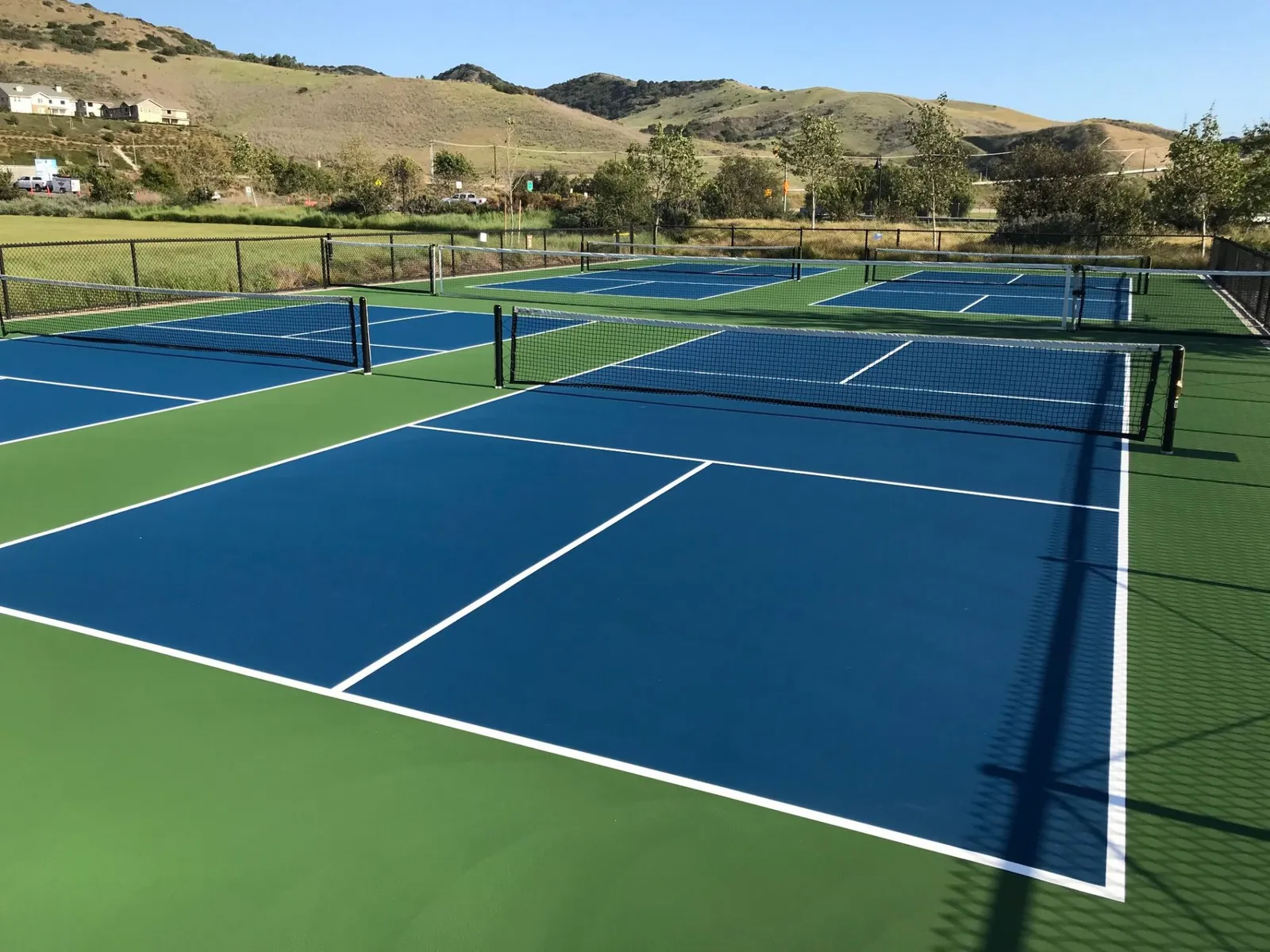
Pickleball has fewer lines than tennis, but every single one carries specific weight in how a point gets decided. Missing what a line means, or where exactly it sits, is one of the fastest ways to lose a point on a technicality you didn't know existed.
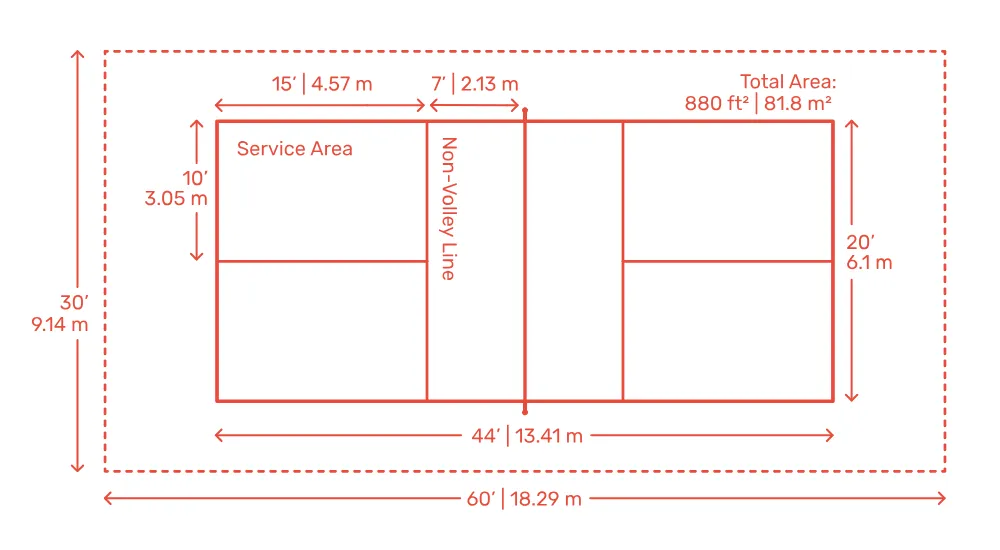
A regulation pickleball court has six functionally distinct lines, all 2 inches wide:
- the baseline
- two sidelines
- the non-volley zone line on each side of the net
- the centerline behind each non-volley zone
- the service court sidelines that mark the outer boundary of the service courts (shared with the main sidelines)
Every one of these lines sits within the court's overall 20-by-44-foot playing surface. We covered this in full in our pickleball court layout guide.
The Baseline
The baseline runs along the very back of the court on each side, 22 feet from the net. It marks the outer boundary for how deep a shot can land and still be considered in play. A serve, groundstroke, or lob that lands beyond the baseline is out, full stop, regardless of how close it was.
Baselines are also the starting position for every serve. A server must have both feet behind the baseline, not touching it, at the moment of contact.
Sidelines
The two sidelines run the full 44-foot length of the court, one on each side, marking the outer left and right boundaries. Like the baseline, any shot landing outside the sideline is out. The sidelines double as the outer boundary for both the service courts and the non-volley zone, since the kitchen spans the court's full 20-foot width between them.
Non-Volley Zone Line (the Kitchen Line)
The non-volley zone line sits 7 feet back from the net on each side and marks the outer edge of the kitchen. This is the most consequential line on the court, since it governs where a player can and cannot volley the ball. A player who touches this line while volleying, even with a single toe, commits a fault.
We cover the full rule, including what counts as a fault and why the zone exists in the first place, in our dedicated guide to the non-volley zone.
Centerline
The centerline runs from the non-volley zone line back to the baseline on each side of the court, splitting the area behind the kitchen into a right service court and a left service court. It exists specifically to guide where a serve must land, since every serve is hit diagonally into the opposite service court.
However, the centerline does not continue into the non-volley zone. The kitchen is one unbroken 20-foot-wide strip with no center division, so once a rally moves past the kitchen line and into net play, the centerline no longer applies to where a shot must land.
Service Court Lines
The service courts, sometimes just called the "boxes," are the two rectangles on each side of the court bordered by the sideline, the baseline, the centerline, and the non-volley zone line. Each measures roughly 15 by 10 feet. Every serve in the game must land inside the opposite diagonal service court, clearing the net and landing beyond the kitchen line, never inside it.
Line | Location | What it governs |
|---|---|---|
Baseline | 22 ft from the net, both ends | Back boundary and serving position |
Sideline | Full length, both sides | Left and right boundary |
Non-volley zone line | 7 ft from the net, both sides | Where volleys are prohibited |
Centerline | Behind each kitchen, splitting service courts | Divides serves into left and right target areas |
Are Lines In or Out?
Every line on a regulation pickleball court is considered part of the court it borders, the same convention used in tennis. A ball that lands with any part of it touching a boundary line is called in, not out. This applies to the baseline, sidelines, and non-volley zone line alike.
The same logic works in reverse for players. A foot touching the non-volley zone line during a volley counts as being inside the kitchen, not outside it, which is why line judges and self-officiating players alike are trained to watch feet as closely as the ball.
Read more about pickleball scoring in our guide.
Ready to see these lines in person? Browse verified courts near you at courts.thepicklebase.com and follow @thepicklebase for more rule breakdowns from the region.
Common questions
What color are pickleball court lines supposed to be?
There's no single mandated color, but lines need to contrast clearly against the court surface. Blue or green courts with white or yellow lines are common at competitive venues, chosen specifically to make lines easy to track against a bright pickleball ball.
Why is the kitchen line treated differently from the other lines?
Every other line on the court determines whether a ball is in or out. The kitchen line is unique because it also restricts player movement and shot type, not just ball landing position, which is why it carries its own dedicated rule.
Do indoor and outdoor courts use different line colors or widths?
Line width stays the same at 2 inches regardless of venue. Color choice can vary more indoors, where lighting conditions differ from natural daylight outdoors. We compare both environments in our indoor vs outdoor courts guide.
Does a serve that lands on the centerline count as in?
Yes. The centerline, like every other court line, counts as part of whichever service court it borders.