
A new player standing on a pickleball court for the first time usually has one of two reactions. Either the court feels tiny compared to the tennis courts they grew up on, or it feels oddly cramped near the net once someone explains the kitchen rule.
Both reactions are valid and correct. A pickleball court is small by design, and that compactness is exactly what makes the sport playable by both a 12-year-old and a 70-year-old in the same rec session. Understanding the layout is the fastest way to stop double faulting on positioning and start reading the court like someone who has actually played.
The Basic Rectangle
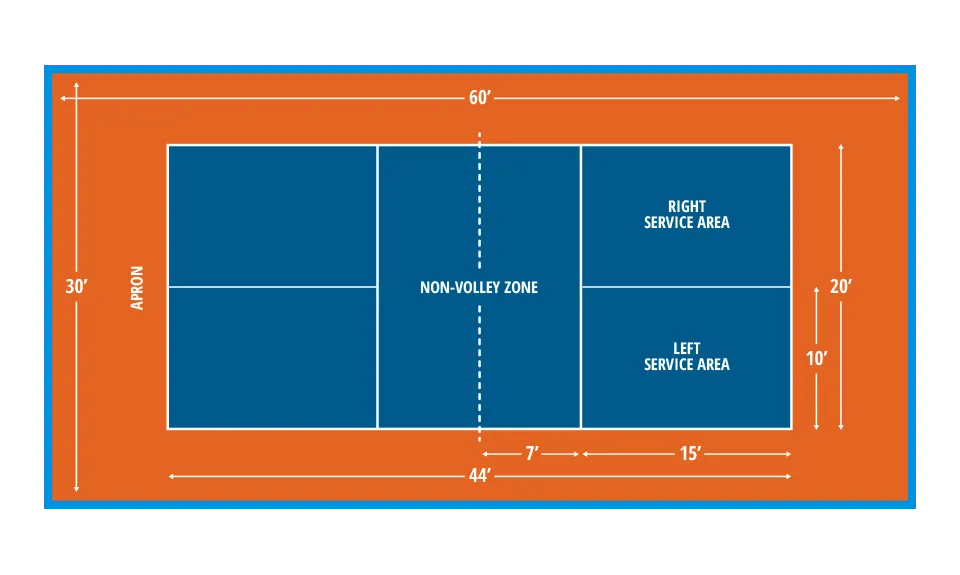
A regulation pickleball court measures 20 feet wide by 44 feet long (6.1 by 13.41 meters). This holds for both singles and doubles play. It's quite a culture shock for tennis veterans playing pickleball for the first time. In pickleball, everyone plays inside the same 20-by-44-foot rectangle.
To put the scale in perspective, a full pickleball court is roughly one third the size of a tennis court. You can fit four pickleball courts inside the footprint of a single tennis court, which is a big part of why so many facilities in Malaysia and across Southeast Asia have converted underused tennis courts into multi-court pickleball setups. For the exact conversion math and what a build actually costs, see our complete guide to pickleball court size.
The net divides the court into two halves, each 22 by 20 feet. Each half is then divided further into the zones below.
Singles vs doubles layout: Unlike tennis, pickleball does not shrink the court for singles play. Every dimension, from the sidelines to the kitchen to the service courts, stays identical whether it is two players on court or four. The only real strategic shift is that singles players have to cover the full 20-foot width alone, which is one reason the format tends to favor speed and shot placement over the net-based teamwork that defines doubles. |
The Non-Volley Zone
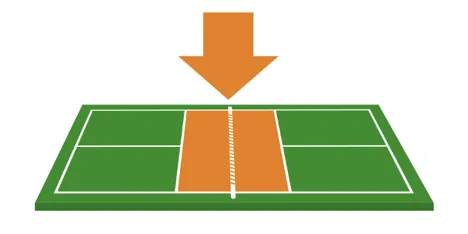
The most talked about part of any pickleball court is the seven-foot zone on each side of the net, known as the non-volley zone or, more commonly, the kitchen. Players cannot hit the ball out of the air while standing inside this zone or touching its lines. The ball has to bounce first. Here's a guide that explains pickleball rules for beginners.
The kitchen runs the full 20-foot width of the court and extends seven feet back from the net on both sides, giving a combined depth of 14 feet when you count both halves. This is the rule that shapes almost every strategic decision in pickleball, from the third shot drop to the dink battles that decide most rallies at intermediate and advanced levels. We go into exactly why this zone exists and how it changes the way the sport is played in our full breakdown of the non-volley zone.
Service Courts and the Centerline
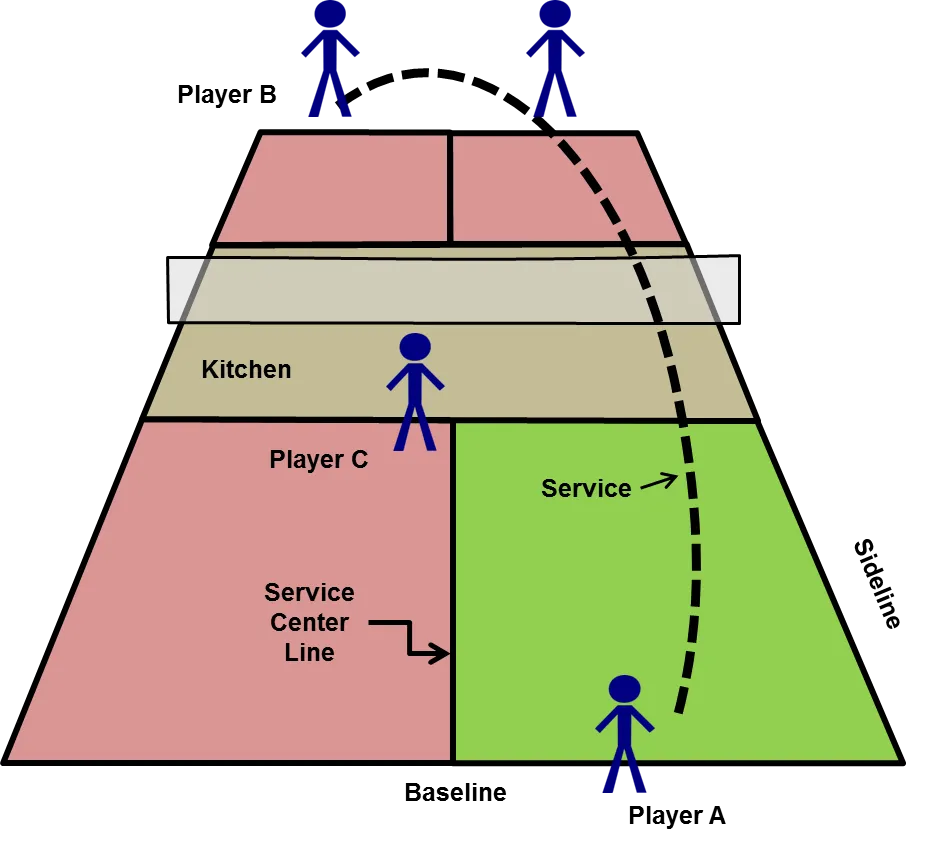
Behind each kitchen line sits a 15-by-20-foot area split down the middle by a centerline, creating a right service court and a left service court on each side of the net. Serves are always hit diagonally, cross-court, into the opposite service court, the same way a tennis serve travels diagonally into the service box.
The centerline only exists behind the kitchen line. It does not extend into the non-volley zone, since the kitchen is a single unbroken 20-foot-wide strip with no center division. This detail catches out a surprising number of newer players who assume the centerline runs the full length of the court.
For a full breakdown of every individual line and what each one means for gameplay, read our companion piece on pickleball court lines.
The Net
The net sits at the court's midpoint and spans at least 21 feet 9 inches between posts, with the posts themselves typically set just outside the sidelines so the net measures roughly 22 feet edge to edge. Net height is 36 inches at the sidelines and 34 inches at the center, a two-inch sag that is intentional and regulated.
That two-inch difference matters more than most players realize, since it changes where a shot clears the net most easily. For the full net specification, including post placement and material standards, see our guide to official pickleball net measurements.
Recommended Playing Space
The 20 by 44 foot figure only covers the in-bounds playing surface. USA Pickleball recommends a minimum total space of 30 by 60 feet to give players room to move, chase down lobs, and avoid running into a fence or wall mid-rally. Tournament and premium facility builds usually go further, allowing 34 by 64 feet or more.
Space type | Dimensions | Use case |
|---|---|---|
Playing surface | 20 ft x 44 ft | The in-bounds court itself |
Minimum recommended area | 30 ft x 60 ft | Backyard and recreational builds |
Tournament standard | 34 ft x 64 ft | Competitive and club facilities |
Facilities that skimp on run-off space tend to see more collisions with fencing and more balls landing on neighboring courts, so this is one number worth not cutting corners on if you are involved in planning a build.
Looking for somewhere in the region to actually play on a court like the one above? Browse verified venues near you at courts.thepicklebase.com and follow @thepicklebase for more court breakdowns and local venue drops.
Common questions
Why doesn't the centerline run through the kitchen?
The non-volley zone is a single continuous strip across the full width of the court. Splitting it with a centerline would create confusion at the net, where players from both the left and right side regularly cross into the middle to defend.
Is the court the same size indoors and outdoors?
Yes. The 20 by 44 foot playing surface is identical regardless of venue. What changes indoors versus outdoors is usually the run-off space, ceiling height, and surface material. We cover those differences in our indoor vs outdoor courts guide.
How wide are the court lines themselves?
All lines are 2 inches wide, and the ball is considered in if any part of it touches the line, the same convention used in tennis.
Can I build a court that's smaller than regulation?
You can, but it stops being a regulation court. Many backyard builds compress the run-off space rather than the 20 by 44 foot playing area, since shrinking the actual court changes how the game plays.