
Both indoor and outdoor pickleballs have to meet the same USA Pickleball equipment standard. In our guide about pickleball balls, they must have a hardness of 40- 50 on the Durometer D scale, be 2.87-2.97 inches in diameter, and weigh 0.78-0.935 ounces. Within those shared limits, manufacturers adjust hole count, plastic type, and wall thickness to tune each ball for a completely different environment.
Both indoor and outdoor balls need to adhere to the same standard, but it doesn't mean that they are interchangeable.
When playing outdoors, you have to take into account weather, especially the wind. A mild 10 mph breeze changes the trajectory of a lob, a reset, or a high-arcing third shot drop. Outdoor balls are designed to resist wind by being heavier and having more holes.
In this guide, we will explore the difference between indoor and outdoor pickleball balls. This way, you won't mix them up.
What Is an Indoor Pickleball?
An indoor pickleball is built for a still-air environment. This can be a gym floor, a converted badminton hall, or a covered community court where wind isn't a factor. Because there's no crosswind to fight, indoor balls are engineered around control and touch instead of wind resistance.
Here are characteristics of an indoor pickleball:
- Around 26 holes, larger in diameter, which keeps the ball lighter and easier to feel through soft shots. This slows the ball's travel speed by roughly 15–20% compared to an outdoor ball, leading to longer dinking exchanges and controlled rallies.
- Softer polyethylene plastic, which flexes more on contact for better touch at the kitchen line
- Lighter overall weight, roughly 22 grams, since it doesn't need the extra mass required to punch through wind
- Slower, more forgiving flight, suited to the shorter, more controlled rallies typical of indoor courts
Indoor balls are lighter and float more easily, which is fine on a controlled gym floor but becomes a liability the moment there's any airflow.
What Is an Outdoor Pickleball?
Outdoor pickleballs are built for textured, gritty surfaces like acrylic courts, asphalt, and concrete. They are designed to withstand wind resistance, rough ground friction, and high-velocity play.
- 40 Smaller Holes: Outdoor balls feature 40 smaller, precision-drilled holes. This pattern creates lower aerodynamic drag and cuts through crosswinds, helping the ball maintain a straight flight path outdoors.
- Harder Plastic Composition: Made from denser, more rigid polymers, outdoor balls bounce lower, travel significantly faster, and pop off the paddle face with high velocity.
- Skid & Texture Interaction: The rough texture of outdoor court surfaces grips the smooth plastic surface. This leads to faster off-the-bounce skid and forces players to react quicker compared to gym floor play.
- Temperature Sensitivity: Because the plastic is rigid, cold weather makes outdoor balls brittle. Below 50°F (10°C), outdoor balls are far more prone to cracking, cracking along seam lines, or going out-of-round (warping).
- High-Pitch Sound: The combination of dense plastic and hard court surfaces produces a loud, high-pitched cracking sound upon impact.
- Heavier overall weight, roughly 25 to 26.6 grams, giving the ball enough mass to punch through crosswinds.
More holes generally means more aerodynamic drag, and that drag is precisely what keeps an outdoor ball from ballooning off course in the wind. The firmer plastic that makes this possible comes with a trade-off, covered below.
Indoor vs. Outdoor: Side-by-Side Comparison
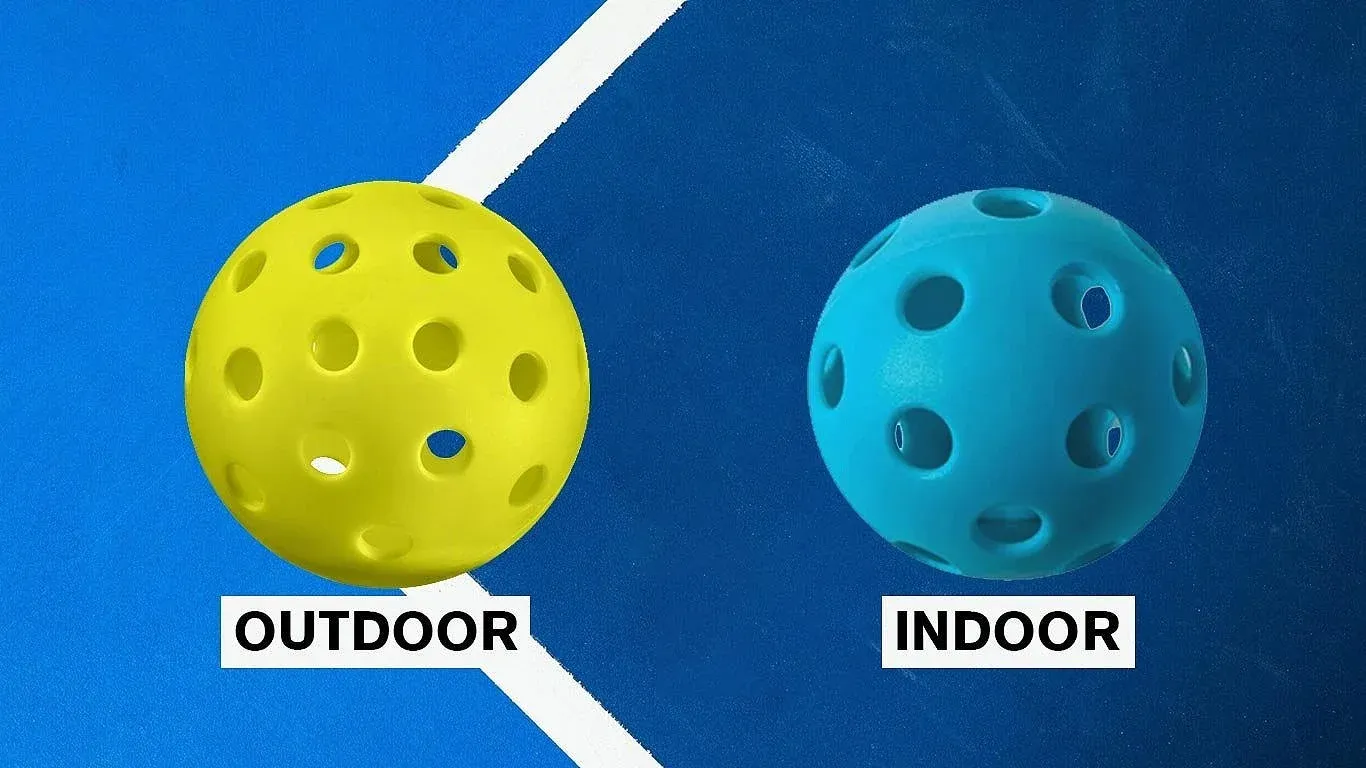
Indoor Ball | Outdoor Ball | |
|---|---|---|
Hole count | About 26, larger holes | About 40, smaller holes |
Weight | Roughly 22 grams, lighter | Roughly 25 to 26.6 grams, heavier |
Plastic | Softer polyethylene | Firmer, smoother polypropylene |
Built to resist | Nothing, still-air environment | Wind |
Feel | Slower, softer, more forgiving | Harder, faster, truer flight in wind |
Best surface | Gym floor, wood or composite | Concrete, asphalt |
Weak point | Wears out fast outdoors, drifts in wind | Cracks in cold, softens in heat |
What Happens When You Use the Wrong Ball?
Using the wrong pickleball on a court instantly degrades gameplay, accelerates gear wear, and alters ball physics.
Using an Indoor Ball Outdoors
The softer plastic wears down quickly against rough concrete, and the larger holes that were designed for still air start catching wind instead, making the ball drift unpredictably rather than holding a straight line. Within a session or two outdoors, an indoor ball will typically be cracked or unplayable.
- Extreme Bouncing: The softer plastic bounces unnaturally high off hard outdoor surfaces. Shots hit at shoulder height end up bouncing over players' heads.
- Erratic Flight in Wind: Because indoor balls are lighter and have 26 larger holes, even a light breeze will drift, stall, or push the ball wildly off-course.
- Rapid Surface Abrasion: Gritty asphalt or textured acrylic courts act like sandpaper on soft indoor plastic. The ball scuffs quickly, develops rough patches, and loses its smooth finish within a few games.
- Slower, "Squishy" Feel: Hard drives lose their pop because the soft plastic absorbs impact energy against the paddle rather than transferring velocity.
Using an Outdoor Ball Indoors
This mismatch is less destructive but still noticeable. The firmer plastic and smaller holes make the ball feel harder and louder off the paddle than the softer indoor ball a gym floor is designed around.
- Low, Dead Bounce: Smooth hardwood gym floors lack the surface friction needed to compress dense plastic. The ball skid-bounces flat and low, making standard dinks and drops hit the bottom of the net.
- Loud, Jarring Acoustics: The hard polymer combined with hollow gymnasium acoustics creates an intense, high-pitched "thack" sound that echoes loudly off gym walls.
- Faster Plastic Cracking: Outdoor balls depend on textured surfaces to absorb kinetic energy. Slamming rigid plastic onto unyielding wood floors increases stress on the seams, causing outdoor balls to crack faster indoors than they normally would.
- Slippage on Smooth Surfaces: The harder, slicker plastic offers very little grip on finished basketball courts, causing the ball to slide off the floor on topspin or slice shots rather than gripping and bouncing up.
Which Ball Should You Actually Buy First?
If you only play outdoors, or you're not sure yet where most of your games will happen, buy the outdoor ball. Most casual and club-level pickleball in Malaysia and across Southeast Asia happens on outdoor hard courts. If your group splits time between an air-conditioned hall and an outdoor court, keep one sleeve of each in your bag rather than trying to make one ball work for both.
Switching Courts in Malaysia and Southeast Asia
Surface-switching is more common here than in a lot of other regions, since players often bounce between covered community hall courts and outdoor public courts depending on the weather or time of day. Heat is the extra variable to plan around. Outdoor balls in tropical conditions soften and lose bounce consistency faster than they would in a temperate climate, so a ball that felt tournament-fresh in the morning may already feel dead by an evening session. For a closer look at how the surface itself changes the game, see our guide on indoor vs. outdoor pickleball courts.
Find a court that matches your ball at courts.thepicklebase.com, and follow @thepicklebase on Instagram for more gear breakdowns.
Common Questions
Can I tell an indoor ball from an outdoor ball just by looking at it?
Usually yes. Count the holes. Around 26 larger holes signal indoor, around 40 smaller holes signals outdoor. Indoor balls also tend to feel noticeably softer when you squeeze them.
Will an outdoor ball damage an indoor gym floor?
It won't damage the floor, but the firmer plastic and different bounce profile will feel off and louder compared to the ball the court was set up for.
Why does my outdoor ball crack in cold weather but not in the heat?
Cold makes the firmer outdoor plastic more brittle and prone to splitting on impact. Heat is a different problem: it doesn't crack the ball, but it does soften it and shorten its useful lifespan.
Is one ball type more expensive than the other?
Not meaningfully. Both indoor and outdoor balls are sold at similar price points, generally a dollar or two per ball depending on brand and pack size, or less when bought in bulk.