
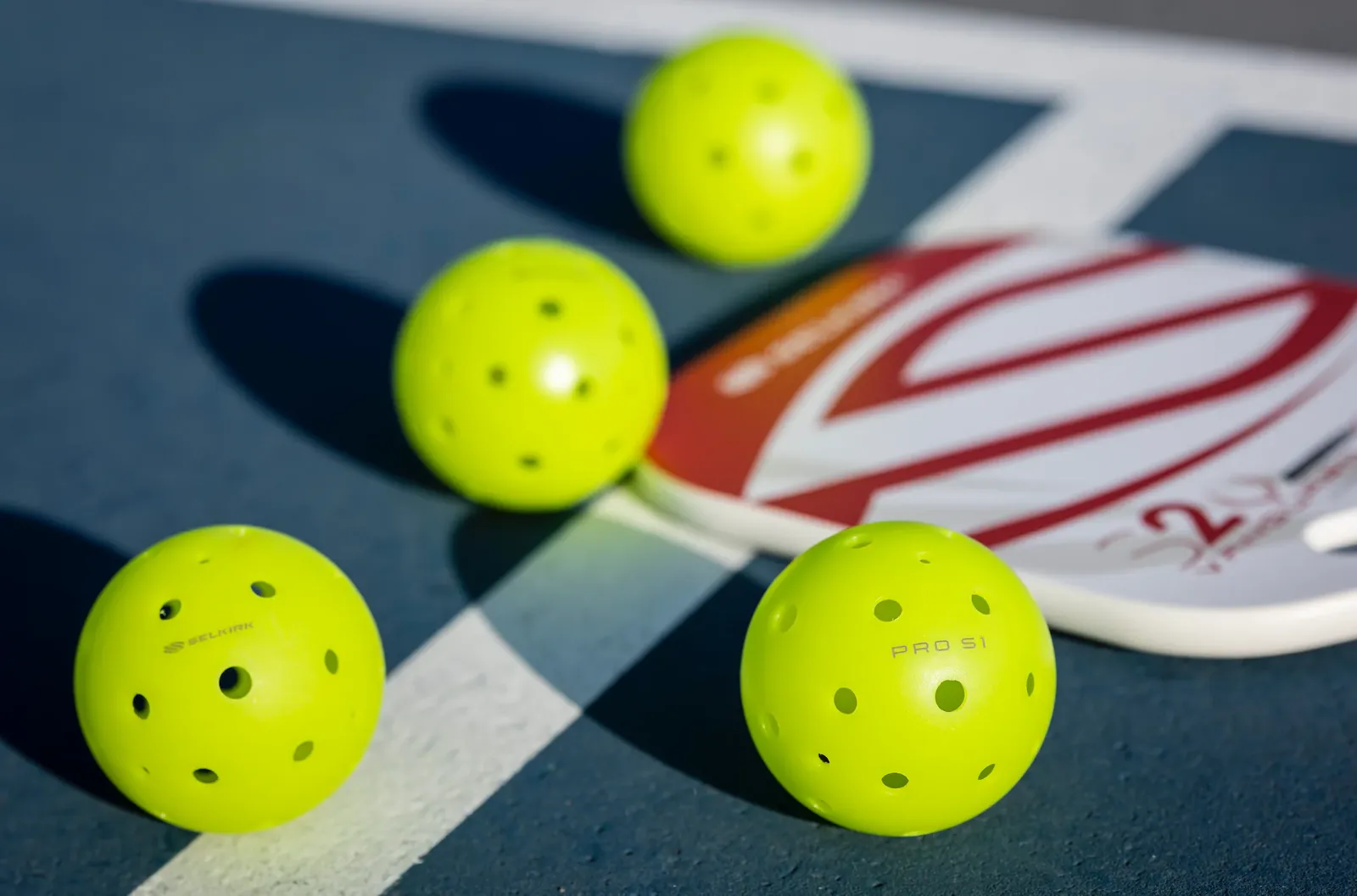
Every pickleball has to meet the same USA Pickleball equipment standard to be tournament-legal, whether it is $0.25 or $3. According to PickleballUS's indoor vs. outdoor ball breakdown, a ball needs to be:
- Between 40-50 on the Durometer D scale
- 2.87-2.97 inches in diameter
- Weighs 0.78-0.935 ounces
Manufacturers must adhere to these numbers and then tune hole count, wall thickness, and construction method to fit either an indoor gym floor or an outdoor court.
Knowing those levers is what actually separates a good ball choice from a random one at the sporting goods store.
Seamless vs. Seamed Construction
Balls are built as a single piece (seamless) or through injection molding (seamed). They differ in how straight they fly and how long they last:
- Rotational molding (one-piece, seamless). Molten plastic coats the inside of a spinning mold, creating a single, seamless shell with even wall thickness throughout. Once it cools, the holes are drilled. This process produces the truest flight and roundest ball, which is why it's the standard for tournament-grade balls.
- Injection molding (two-piece, seamed). Two hemispheres are molded separately and fused, leaving a seam around the equator. That seam adds extra wall thickness and weight right at the joint, by more than 30% according to Cheetah Pickleball's technical comparison. This throws off the ball's balance just enough to make flight and bounce slightly less predictable. Seamed balls tend to be cheaper and feel softer off the paddle, which is why they're common in casual rec bins.
Practical takeaway: if you're buying for competitive or league play, look for "seamless" or "one-piece" on the packaging. For casual backyard games, a seamed ball is a perfectly fine and cheaper choice. |
Do Holes Make a Difference?
Hole count is the single biggest factor in how a ball behaves in the air, and it's also the main thing that separates an indoor ball from an outdoor one.
Hole Count | Typical Use | Why |
|---|---|---|
26 holes (larger holes) | Indoor | Larger holes create less drag at low speed but more surface for gym-floor conditions, producing a softer, slower flight suited to controlled indoor air |
40 holes (smaller holes) | Outdoor | More, smaller holes create the drag needed to hold a straight line through wind and resist the ball ballooning off course |
More holes generally means more drag, which slows the ball down and makes it more controllable indoors. Meanwhile, fewer holes reduce drag and let the ball travel farther and straighter outdoors. USA Pickleball doesn't actually mandate a specific hole count whether you play indoors or outdoors. The organization approves balls in the 26-40 range, but manufacturers converge on those two numbers because the physics rewards them.
For the full physical breakdown of why outdoor balls crack faster and feel heavier, see our Indoor vs. Outdoor Pickleball Balls guide.
Ball Materials
Every pickleball is molded from a hard plastic polymer, and the specific type used has as much influence on feel as hole count or seam construction. Two materials dominate the market.
Material | Feel | Typical Use | Why |
|---|---|---|---|
Polyethylene (PE) | Softer, more flexible | Most common in indoor balls | Flexes on impact for better touch and control on smooth gym floors |
Polypropylene (PP) | Stiffer, harder | Most common in outdoor balls | Resists moisture, UV exposure, and the repeated impact of concrete and asphalt |
Polyethylene is prized for its flexibility and toughness, which is why it shows up most often in indoor balls, where a softer touch on smooth gym floors matters more than weather resistance. Polypropylene trades some of that softness for stiffness and durability, holding up better against rough outdoor surfaces and resisting moisture, chemical exposure, and UV degradation.
Some manufacturers blend the two polymers, or add UV stabilizers to an otherwise standard plastic, to fine-tune a ball's speed, spin response, and crack resistance for a specific climate or playing surface.
At the budget end of the market, some balls use generic PVC or unbranded plastic blends. These are cheaper but noticeably less consistent in bounce and durability than balls built from proper PE or PP resin.
Practical takeaway: if a ball's packaging doesn't specify PE or PP, treat that as a signal it may be a budget, less consistent product rather than a tournament-grade one, regardless of hole count or seam claims. |
Reading a Ball's Bounce and Firmness
Firmness and bounce consistency come down to wall thickness and plastic blend. Thicker walls add durability but reduce feel and touch, while softer walls give more feedback at the cost of a shorter lifespan. Outdoor balls generally use a firmer polypropylene blend to survive concrete and asphalt, while indoor balls use a softer polyethylene blend suited to a wood or composite gym floor.
A quick way to spot a warped or off-balance ball before you buy a full sleeve is to roll it across a flat table. A ball with uneven wall thickness, common in cheaper seamed construction, will wobble rather than roll true.
You Don't Need Tournament Balls for Rec Play
It's easy to assume the ball your favorite pro uses is the one you should buy in bulk for weekend games with friends. Tournament-grade seamless balls cost more per unit and are built to hold up under sanctioned, high-intensity conditions.
For casual rec play, a cheaper seamed ball plays fine and saves money, especially if your group goes through balls quickly from mishits into fences or off-court retrieval.
Save the seamless, USA Pickleball-approved balls for league nights, tournaments, or serious practice sessions where consistent bounce actually matters to your game.
Buying Balls in Malaysia and Southeast Asia
Outdoor courts across Malaysia, Singapore, the Philippines, and Vietnam run hotter and more humid than the US conditions most balls are tested in, which softens plastic faster and shortens a ball's usable life in a single session. Court hosts running regular games should budget for replacing outdoor balls more often than the packaging suggests, and keep a spare sleeve of indoor balls on hand for any covered or air-conditioned court bookings.
Looking for somewhere to actually use that new sleeve of balls? Browse court listings at courts.thepicklebase.com and follow @thepicklebase on Instagram for more gear breakdowns.
Common Questions
Can I use an indoor ball outdoors in a pinch?
You can, but it plays poorly. Indoor balls are lighter and softer, so they drift in even a light breeze and wear out fast on rough outdoor surfaces.
Why do some balls crack after just a few sessions?
Cold temperatures make plastic more brittle, and rough outdoor surfaces like concrete accelerate wear. Seamed balls are also more prone to splitting at the joint than seamless ones.
Does hole count affect legality for tournaments?
No. USA Pickleball approves balls with hole counts anywhere from 26 to 40, as long as the ball meets the firmness, diameter, and weight standards.
What's the single best all-around ball to buy first?
For most new players and court hosts, a USA Pickleball-approved outdoor ball like the Franklin X-40 is the safest single purchase, since most casual play happens outdoors.