
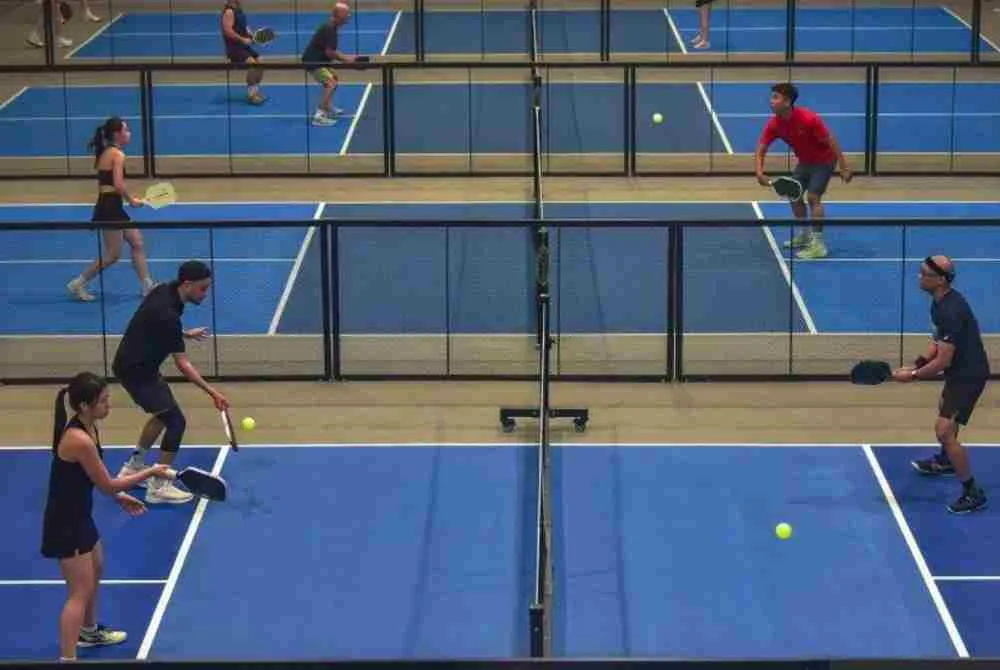
Look around any recreational park or sports complex right now. There's a decent chance a badminton court has been repainted with pickleball lines. That image is making a lot of badminton traditionalists nervous, yet the panic is understandable but misplaced.
The Sport Swap That Has Everyone Talking
Pickle-fever is felt now more than ever in Southeast Asia. The primary cause of its takeover is its seamless integration with the region's deeply rooted racquet sports culture. Badminton, tennis, and table tennis players are able to pick up the game instantly. Furthermore, it has a low physical barrier of entry, appealing to all sorts of players, particularly social media-savvy demographics.
Its court dimensions match a doubles badminton court, enabling venue operators in dense urban hubs to rapidly convert existing spaces into courts with minimal investment.
A survey from the United Pickleball Association (UPA) Asia and YouGov Singapore across 12 Asian territories found that 28% of pickleball players across Asia reported transitioning directly from existing racquet sports backgrounds. Approximately 18% of traditional badminton fans in the region now actively follow and play pickleball.
The survey also highlighted why they are playing pickleball. From across 14,000 participants, they found out:
- 35% cite the sport being genuinely more fun and playful.
- 33% play for physical health without the heavy joint impact.
- 31% chose it specifically because it is much easier to pick up than tennis or advanced badminton.
- 29% were drawn in because friends or family members were playing.
This visible, documented shift has everyone asking: will pickleball be the end of badminton?
What Pickleball Cannot Take from Badminton
While pickleball and badminton share a nearly identical court footprint, they are fundamentally different sports. Obviously, they are very different in terms of equipment and rules. But what people fail to realize is they also require different physical demands.
Physical Movement & Footwork Patterns
Badminton requires constant vertical acceleration and deep decelerations. Players sprint forward to net-drop, retreat backward for overhead smashes, and push off aggressively in lateral split-steps. Repeated deep lunges at the net put intense torque on the knees, Achilles tendons, and lower back. Because a shuttlecock decelerates quickly in the air, players must generate almost all their own power using full-body rotation and explosive wrist snap.
On the other hand, in pickleball (especially doubles), players move up to the kitchen line (the 7-foot non-volley zone) early in the point and stay there. Once established at the net, movement becomes lateral shuffling within a tight 3-4 foot radius. Because players don't have to jump, smash overhead nearly as often, or cover the backcourt continuously, the wear on knees and lower joints is drastically lower. The movement relies on balanced, athletic ready stances rather than high-impact lunging.
Rally Dynamics & Energy Systems
Badminton is often ranked among the most demanding racquet sports physically. A singles or doubles match keeps heart rates in high anaerobic zones due to rapid-fire smashes and fast recovery strides. Smashes require leaping high into the air to create steep attack angles over a 5-foot net.
Meanwhile, Pickleball trades raw cardiovascular output for quick-reaction hand mechanics. Instead of trying to overpower opponents, high-level players use soft "dinks" (dropping the ball gently over the net into the kitchen so the opponent cannot smash it). This requires patience, paddle-face control, and soft touch. When a fast ball is hit directly at players standing 14 feet apart at the kitchen line, reaction times drop to milliseconds. The focus shifts entirely to quick wrist-and-forearm control to counter or block high-velocity shots.
Saying that pickleball and badminton are the same sport at different speeds is an oversimplification. They require different physical and mental experience. Badminton rewards explosive athleticism, reflexes, and the ability to sustain that intensity for an entire match. Pickleball rewards patience, positioning, and soft-game precision.
People who love the adrenaline of badminton are not going to find a substitute in pickleball.
Beyond sport mechanics, badminton carries cultural weight in this region that no amount of converted courts can erase. It runs from village recreational games all the way to the Olympic stage. That kind of institutional and emotional depth does not simply transfer to a newer sport.
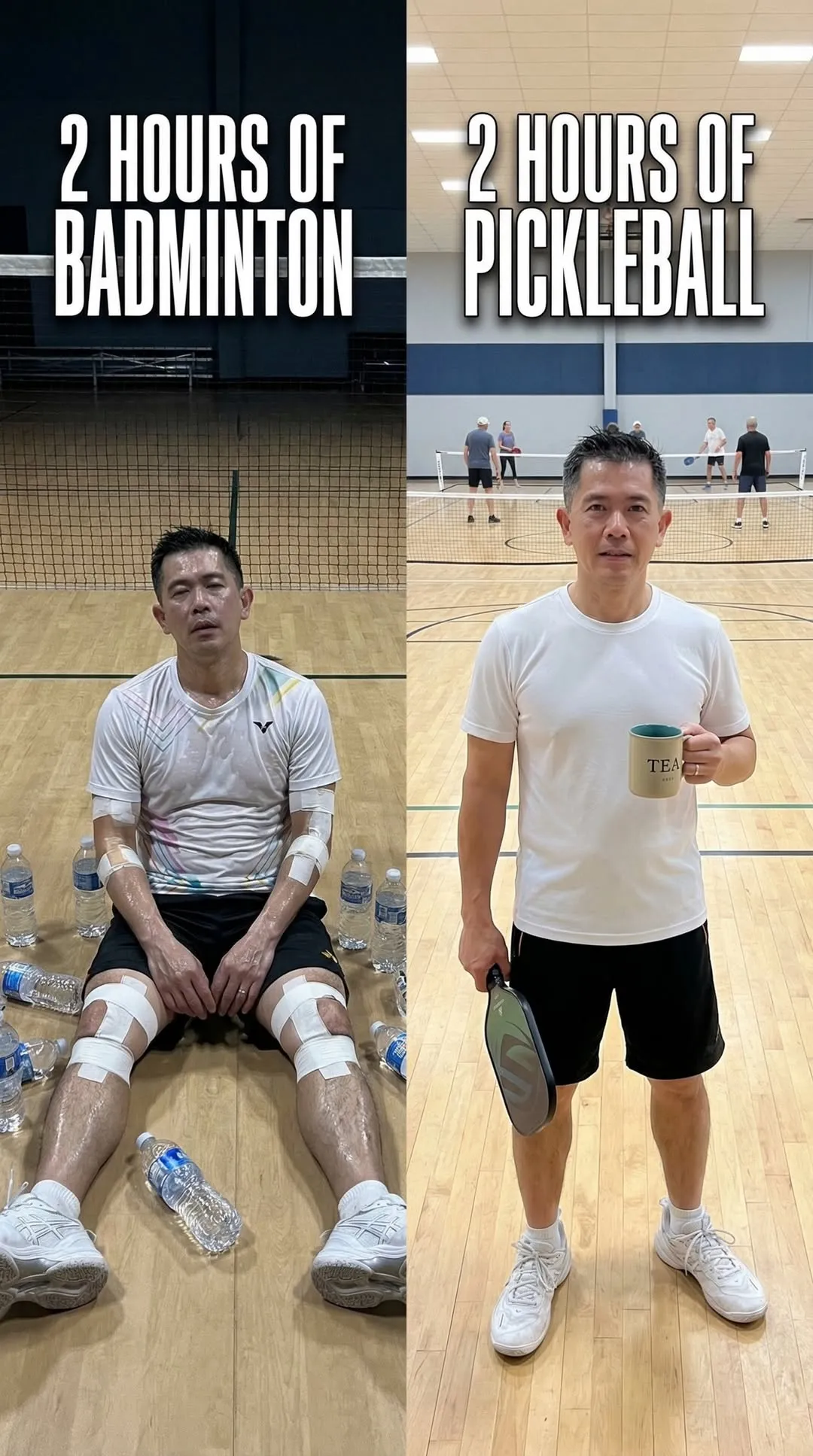
Pickleball is Growing the Pie, Instead of Stealing the Cake
Pickleball is not pulling serious badminton players away. It is pulling in people who were not playing any racquet sport at all.
Whether it's the older adult who stopped playing badminton because their body could not keep up or the working professional who wants a social exercise. These are the people who find pickleball appealing.
Instead of building a competition, pickleball allows racquet sports to be picked up by individuals from all walks of life. A commentary from Sinar Daily sums up the topic:
The two sports are best understood as complementary pursuits, not direct rivals. Both are likely to grow side by side.
The displacement debate is the wrong frame entirely. It assumes sport is a zero-sum market where one game's gain is another's loss. More people playing any racquet sport builds the culture, the infrastructure, and the pipeline of athletic interest that ultimately benefits every sport in the ecosystem.
Pickleball is not coming for badminton's crown. It is filling a gap that badminton, by its own design, was never trying to fill.
The real question is not which sport survives. It is whether the people running these sports are smart enough to work with that reality instead of against it.