
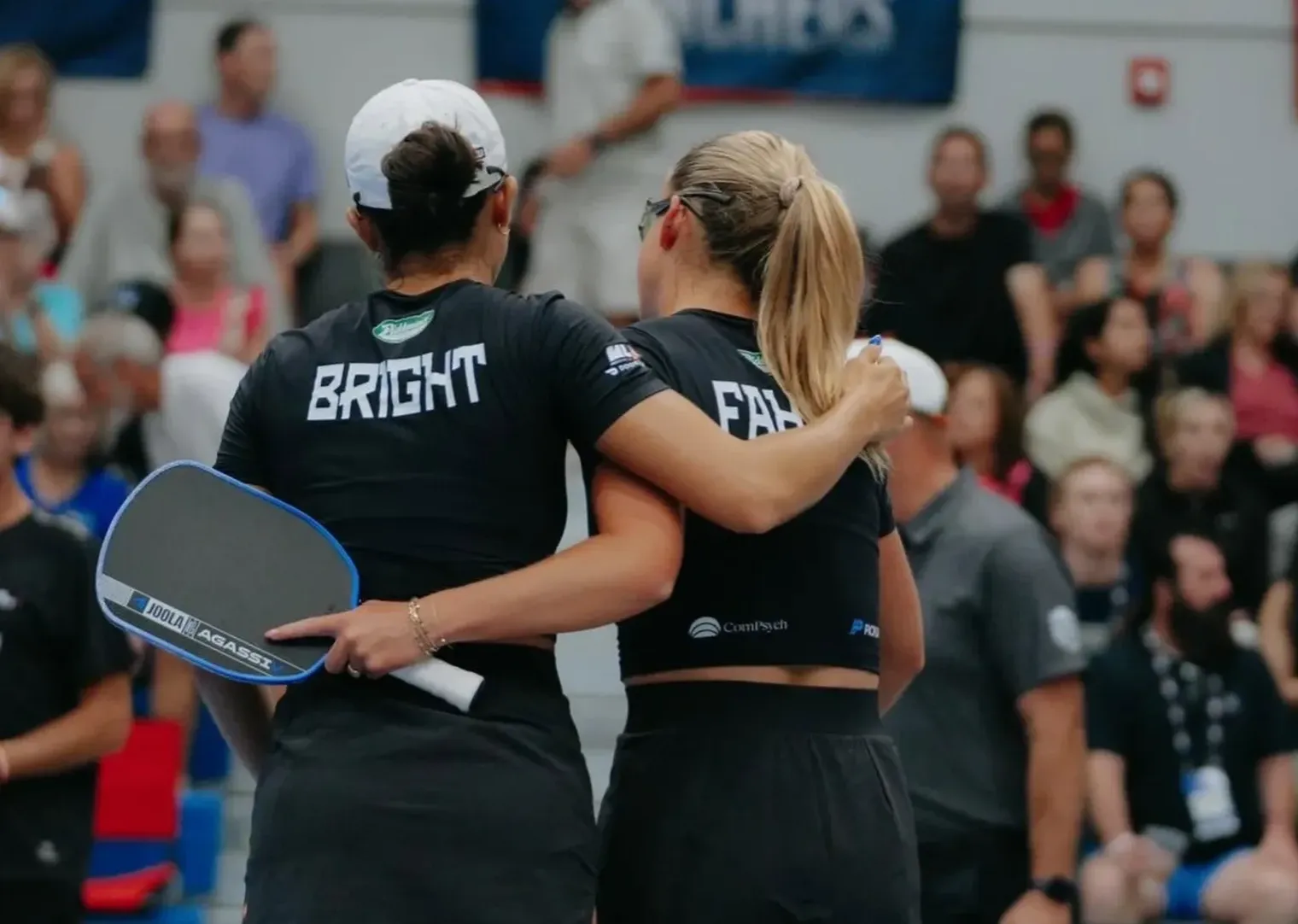
Anna Bright recently published a YouTube video with a title that stopped a lot of people mid-scroll: "Women Don't Matter Enough at Major League Pickleball."
She was talking about a specific structural flaw in the DreamBreaker format. But the questions she raised, about visibility, about who gets credit, about the gap between being known and being good, apply well beyond the courts of a professional team league in the United States.
They apply here too in Asia.
What Bright Actually Said About the DreamBreaker
For those unfamiliar, a DreamBreaker is MLP's tiebreaker format. When teams are level after men's doubles, women's doubles, and mixed doubles, four players alternate in a singles rally-scoring shootout: man, man, woman, woman. The home team sets its lineup first, and the away team responds.
Bright's observation is straightforward but cuts deep: because the best singles players on any MLP roster are almost always men, both teams default to anchoring their lineups with male players at the top. DreamBreakers are typically decided in the first two positions. That means women's singles performance, in a format that is supposed to showcase all four players equally, ends up accounting for a fraction of the action. In a match that runs to 21-19, men play roughly 60% of the points.
Bright explained in the video:
"For every team in MLP, your best absolute level singles players are men. Men simply play more than women in DreamBreakers."
The downstream effect is that teams can build rosters around elite male singles players and treat women's singles as a secondary concern.
She also pointed to something that has quietly disappeared from MLP over the years: the male versus female matchup. In the league's early days, cross-gender points happened regularly and produced some of the most memorable moments in the format's history. Players like Lee Whitwell beating Dekel Bar. Points that still circulate on social media years later. Bright described them as unmatched highlights. Now, with both teams optimising around same-gender matchups, those moments are rare.
Anna Bright: Announce the Matchups, Not the Order
Bright's proposed solution does not require a full format overhaul. Instead of the home team announcing the order of players, she proposes that the home team announces the matchups, and the away team then decides the sequence in which those matchups are played.
This single change would force teams to think strategically about who faces whom, rather than simply stacking men at the top. It opens the door for cross-gender matchups to happen intentionally, turning the DreamBreaker into something far less predictable and far more watchable.
She illustrated this using a theoretical matchup between the St. Louis Shock and the New Jersey 5s. Under her proposed format, a team with strong female talent could engineer a situation where their top woman faces a man, flipping the conventional lineup entirely. The strategy layer deepens. Teams with elite women suddenly have a genuine competitive weapon. And audiences get the drama that made DreamBreakers exciting in the first place.
"It's a DreamBreaker that the people would absolutely love to see. We'd maximize the male versus female matchups, and DreamBreaker strategy would be totally different,"
She called it an unsolved meta, which means more strategy, more head games, more game theory. She hopes to see it introduced in 2027. For a change with that much upside, it would be difficult to argue against.
The Unspoken Ranking System Nobody Talks About
Bright's critique of how women are valued in MLP touches on something that exists in almost every pickleball community. An invisible ranking system that has nothing to do with DUPR.
Nobody talks about it openly. But the moment someone walks onto a pickleball court, people start categorising them.
What club do they play at? Who do they know? Which tournaments have they entered? Are they sponsored? How many followers do they have? Who invited them here?
Before a single ball is hit, a profile has already been created.
Pickleball was supposed to be different. It was the sport that welcomed everyone, where a beginner could rally alongside an experienced player, where community mattered more than status. That promise is still real in many places. But as the sport grows, the same social hierarchies that exist everywhere else are beginning to take shape.
The same players get into almost any game. The same groups travel to tournaments together. The same names appear in every social post. For newcomers, breaking into these circles can feel harder than actually improving their game.
What makes this more complicated is that some players are now managing their pickleball image as carefully as their actual performance. Building visibility. Building relationships. Building influence. Being known can sometimes open more doors than being good. That is not necessarily a bad thing on its own. Every sport has a social layer. But it becomes a problem when the social layer starts to determine who gets opportunities, who gets invited, and who gets seen, regardless of what they can actually do on the court.
A sponsored player is not necessarily the strongest player. A player with thousands of followers is not necessarily better than someone with fifty. A host is not necessarily the most skilled person in the room. Yet these labels carry weight, and most communities have quietly accepted that they do.
The uncomfortable truth is that popularity and ability are not always the same thing. And in a sport that built its identity around inclusivity, it is worth asking whether the communities being built reflect that, or whether they are becoming invite-only ecosystems that just happen to use friendly language.
Is Pickleball Actually a Career?
There is a related conversation about the Asian pickleball scene needing more honesty, and it also connects to what Bright is describing at the professional level.
Here is a simple benchmark worth sitting with: if you are not earning at least RM10,000 a month from pickleball-related income, whether through sponsorships, coaching, tournaments, or content creation, you are not pursuing a profession. You are pursuing a passion. And there is nothing wrong with that. But conflating the two causes real problems.
RM10,000 is not an arbitrary number. In Malaysia, RM3,000 to RM5,000 a month is a survival level for a single person. RM5,000 to RM8,000 is sustainable. RM10,000 and above is what you need to realistically cover EPF contributions, insurance, travel, equipment costs, and future savings. That is the baseline for what a professional income actually looks like.
Many players look at sponsored athletes and think they want that life. But the question worth asking is whether those athletes are actually full-time professionals, or whether they are sponsored hobbyists.
There is a significant difference between receiving a RM1,000 paddle package and earning a RM5,000 monthly retainer. A player might get free gear, tournament entry support, occasional coaching fees, and some prize money, and still earn less than a fresh graduate starting their first job in Kuala Lumpur. The word "sponsored" does not mean what most people assume it means.
Prize Money Is Not a Salary
Many aspiring professionals make the mistake of calculating their potential earnings based on podium finishes. The math can look promising on paper.
But injuries happen. Form drops. New players emerge. Tournament opportunities fluctuate season to season. You cannot budget your mortgage around podium finishes.
This is not unique to pickleball. Look at how most professional players around the world actually make their living. The answer is almost always coaching, clinics, camps, corporate events, and content creation. Competition is often the marketing vehicle for their coaching business, not the other way around.
The players who build sustainable careers in pickleball over the next decade in Malaysia will likely not be the ones who commit everything to competing and hope the prize money adds up. They will be the ones who build coaching practices, develop income streams, and treat the sport as a business platform rather than a lottery.
Not because they love pickleball less. But because they understand that passion and profession are not always the same thing. And because they are honest with themselves about where the money actually comes from.
A useful test: if pickleball disappeared from your life tomorrow, would your financial situation disappear with it? If the answer is yes, that is not a profession. That is dependence.
What All of This Has in Common
Anna Bright's DreamBreaker critique, the invisible social ranking systems in local communities, and the blurry line between sponsorship and professional income all point to the same underlying issue. The gap between how pickleball presents itself and how it actually operates.
Pickleball presents itself as a sport where ability is what matters. Where anyone can play, where community is open, and where hard work translates into opportunity. In many ways, that is still true. But the cracks are becoming more visible as the sport grows.
Women's contributions in MLP DreamBreakers are structurally undervalued by a format that was not designed with them in mind. Social access in local communities is increasingly determined by who you know rather than what you can do. Sponsorship is being conflated with professional success in ways that distort players' thinking about their careers.
Bright's proposed DreamBreaker fix is simple and elegant. The same kind of clear-eyed thinking is needed at the community level. Acknowledging the invisible ranking systems that exist, being honest about what sponsorship actually means financially, and making sure that the sport's growth does not quietly lock out the people it was supposed to welcome.
The biggest ranking system in Asian pickleball may not be DUPR. It may be the one nobody can see.
If you are serious about developing your game the right way, finding a good coach is one of the most direct investments you can make. Browse verified coaches across Malaysia at coach.thepicklebase.com. For the latest news, tournament updates, and community coverage, follow @thepicklebase on Instagram.