
Asia Pickleball Summit 2.0 (APS 2.0) closed out a successful two-day run at Hextar World Exhibition Hall, Empire City, bringing together roughly 1,500 attendees from across the region's pickleball ecosystem. Organised by ReSkills, in partnership with co-organisers Athletes For Athletes (AFA) and Asia Pickleball TV, the summit took place on June 6 and 7, 2026 and positioned itself as one of Asia's largest gatherings dedicated to the sport's business and policy side.
The event marked a clear step up from the inaugural edition, which was held at One World Hotel in Petaling Jaya. This year's venue, more speakers, and more exhibitors signalled how quickly the region's pickleball industry has matured since 2025.
Government Backing and Federation Support

Image courtesy of thestar.com.my
The summit drew official recognition from Malaysia's Ministry of Youth and Sports. Deputy Minister YB Tuan Mordi anak Bimol attended on behalf of Minister YB Dr. Mohammed Taufiq Johari and delivered a keynote address highlighting pickleball's growing role within the country's sports landscape.
Dr. Kelvin Yii Lee Wuen, political secretary to the Minister of Entrepreneur and Cooperatives Development and a Board member of the World Pickleball Federation (WPF), co-officiated the opening alongside APS 2.0 Organising Chairperson Ken Lim. Dr. Yii pointed to pickleball's rapid rise across Southeast Asia and noted that East Asian markets such as Hong Kong, Japan, and China, along with South Asian giant India, are increasingly investing in the sport.
He also called for stronger grassroots development, pushing pickleball into schools and junior-level competition as a foundation for long-term growth, and noted that work is underway to position the sport for inclusion in major multi-sport events such as the Asian Games and the Olympics.
By the Numbers
The official figures from the organisers paint a picture of a summit that scaled significantly from its first edition:
- Approximately 1,500 participants attended across two days
- Representatives from 14 countries took part
- More than 40 international speakers featured across the programme
- 18 conference panels and talks covered governance, business, infrastructure, and athlete development
- Exhibition booths ranged between 26 and 29 depending on the count, showcasing brands in equipment, technology, facilities, and media
- Unlimited networking gameplay sessions ran throughout both days
Organising Chairperson Ken Lim described the format as "2 Days. 3 Experiences," referring to the combination of Conference Talks, Exhibition Expo, and Networking Gameplay that ran in parallel across the venue.
On the Exhibition Floor
The expo area set APS 2.0 apart from a typical conference. Paddle brands including Mehau ran live demo and testing sessions on dedicated courts, letting attendees actually hit a few balls before deciding on gear rather than relying on a booth pitch. Two full courts kept matches running throughout the event, which in turn kept foot traffic circulating through the exhibition space rather than thinning out between sessions.
Beyond paddle brands, floor-covering apparel, court facility operators, media companies, and sports technology providers reflect how broad the regional pickleball supply chain has become.
The Data That Got the Room Talking
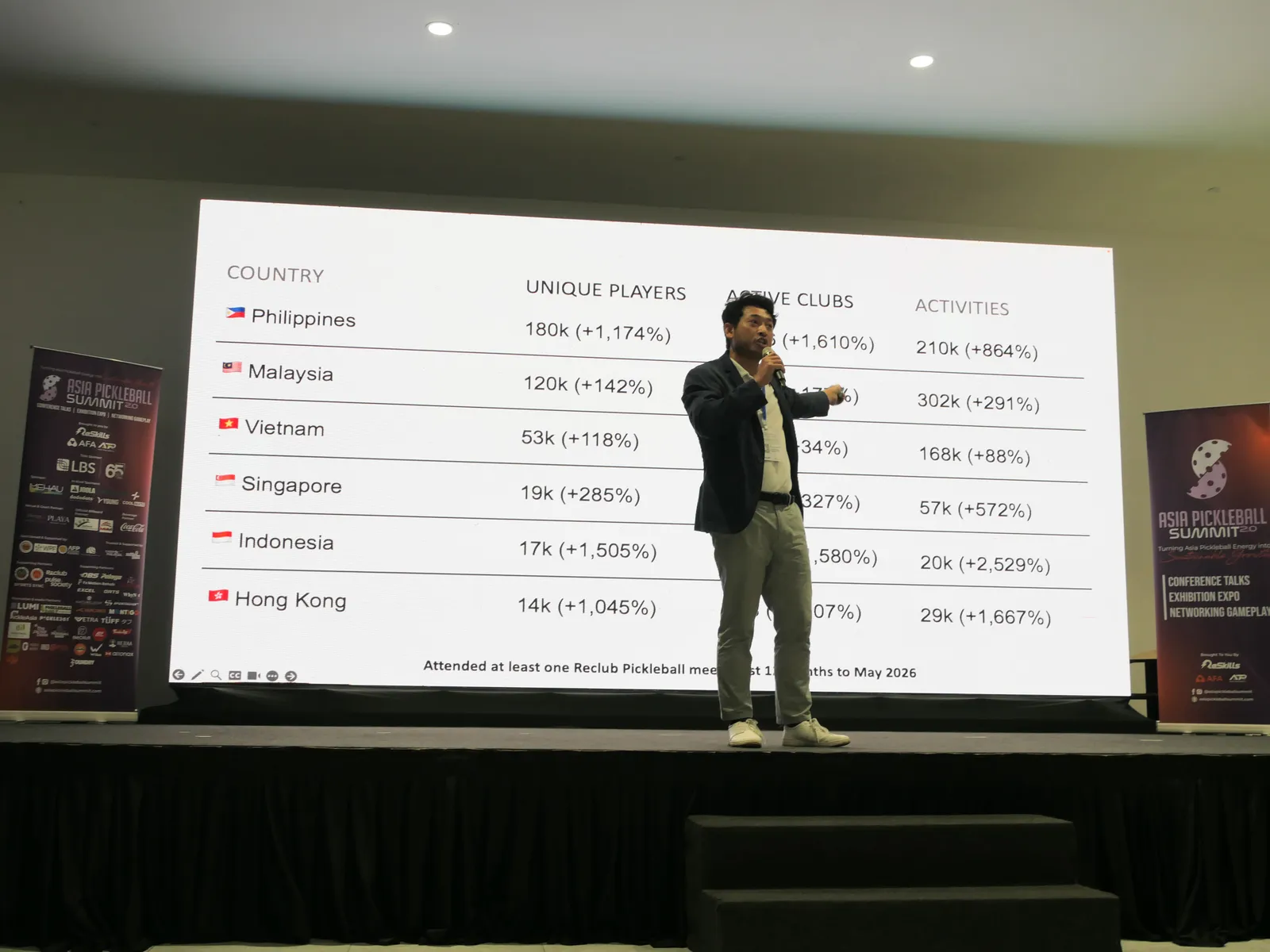
One of the most discussed moments of the summit came from a presentation based on data from Reclub, which tracked unique players, active clubs, and activity volume across Asia over the 12 months leading into May 2026. The numbers showed several Southeast Asian markets moving well past the early adoption stage.
Here are the key points:
- The Philippines led in raw player numbers, with growth figures that treated the room as a genuine inflection point for the market.
- Malaysia ranked second in total players but stood out for its activity density, recording the highest number of activities per player in the dataset, an indicator that the local pickleball community is not just growing in size but playing more often and more consistently.
- Indonesia, despite smaller absolute numbers, posted the steepest growth curve of any market tracked, suggesting it is the next country poised for a serious expansion phase.
- Singapore, Vietnam, and Hong Kong rounded out the markets discussed, each showing strong year-over-year gains in players and activity.
The takeaway is that the Philippines and Malaysia currently anchor the region's pickleball economy, Indonesia is the market to watch next, and Malaysia's high engagement rate gives its coaching, league, and membership businesses a real foundation to build on.
Voices From the Summit

Industry leaders speaking at APS 2.0 echoed a shared theme: the region's growth phase is shifting from awareness to infrastructure.
Kimberly Koh, Managing Director of United Pickleball Association Asia, pointed to Malaysia, Vietnam, and the Philippines as standout markets and said bringing more young players into the sport would help it compete for placement in events like the Asian Games and Olympic Games.
Collin Johns, professional pickleball athlete and RPO Global Technical Director, highlighted Malaysia and Vietnam as countries with strong potential to become frontrunners in international competition, citing investment in coaching as a key driver of future player performance.
Richard Lee, Owner, President and CEO of JOOLA, emphasised the importance of accessible, reasonably priced equipment in helping more young players take up the sport, calling Malaysia's growth trajectory one of the more promising stories in the region.
What Comes Next
Organisers used the closing sessions to confirm plans for Asia Pickleball Summit 3.0, with Ken Lim indicating the next edition will bring in additional resources and international partnerships. The stated goal is to keep building Malaysia's position as a regional hub for the sport, both as a host market and as a base for the industry connections formed at events like this one.
For an event still only in its second year, APS 2.0 made the conversations in Asia's pickleball industry move past whether the sport will grow and into how fast it can be scaled responsibly.
Looking for places to play near you? Browse The Picklebase court directory for venues across Malaysia and the region, and follow us on Instagram @thepicklebase for more coverage from the Asian pickleball scene.