
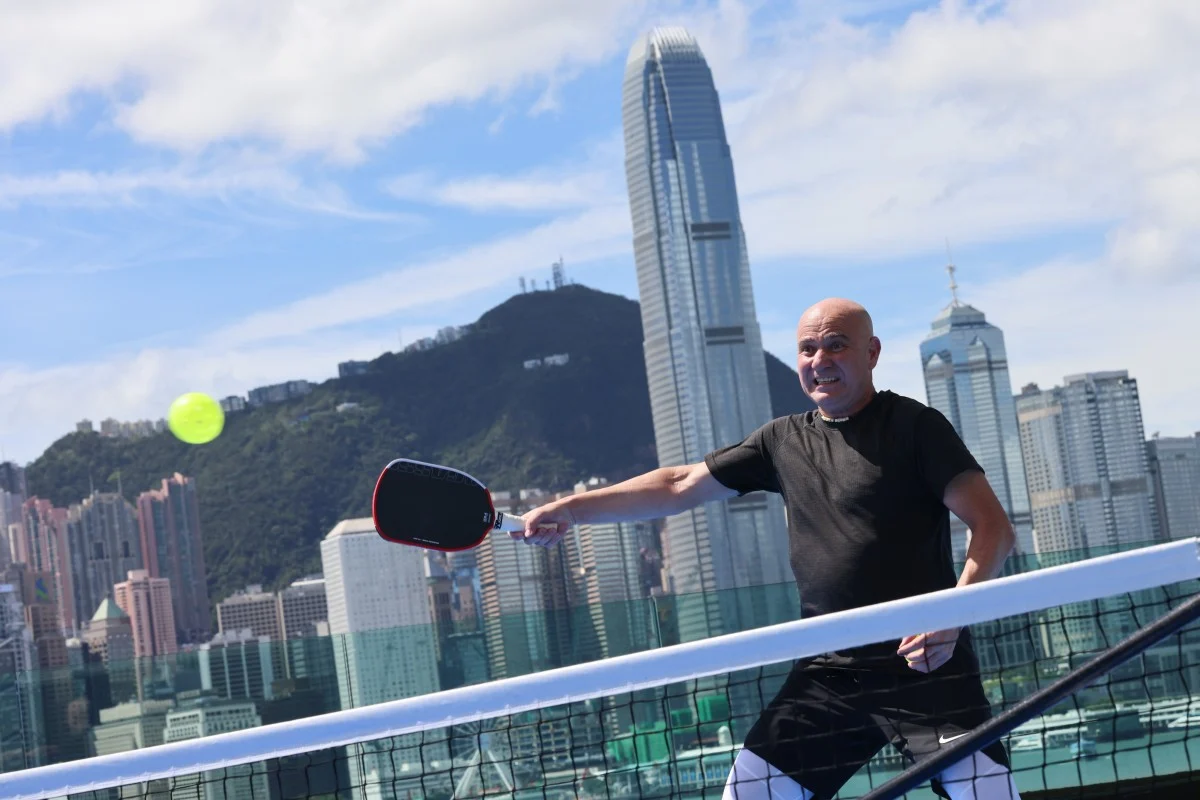
Photo Credits to: South China Morning Post (https://www.scmp.com/sport/hong-kong/article/3329322/tennis-legend-agassi-praises-hong-kongs-exceptional-pickleball-potential)
Eight-time Grand Slam champion Andre Agassi says Hong Kong is primed to become a regional hub for pickleball and indicated he’s ready to play a hands-on role in the city’s next phase of growth.
Agassi, who has emerged as one of pickleball’s most prominent evangelists—making his pro debut at 55, investing in the sport and even designing equipment—argues that Hong Kong’s strengths map neatly to what pickleball needs.
Agassi is in the city for the first time since 1999, when he defeated Boris Becker in the Salem Open final—their last meeting on tour. This week he attended the Prudential NextGen Aces showcase and found a local scene that, by his account, looks ready to scale.
Hong Kong’s Investment and Expansion
Widely described as a mash-up of tennis and table tennis, pickleball has surged at the grassroots level worldwide and is projected to surpass 20 million players globally by next year. Hong Kong is capturing a slice of that momentum: earlier this month, LIT Sports Global—the investment arm of TGG Holdings—signed three Hong Kong athletes to professional contracts. The group also acquired TLP Pickleball Club of Hong Kong with plans to convert it into the city’s first professional pickleball team.
Photo Credits to: South China Morning Post (https://www.scmp.com/sport/hong-kong/article/3329322/tennis-legend-agassi-praises-hong-kongs-exceptional-pickleball-potential)
Community-Driven Growth
While U.S. investors have poured money into professional leagues and TV packages, Agassi cautions that pickleball’s true engine is community play, not media rights. “My belief is in the participation side,” he said. “I don’t know if pickleball will ever translate on TV. That’s the billion-dollar question. Regardless of TV or turning professional, all you need to do is play it.”
He added that the sport’s appeal is its ability to bring people together across ages and abilities. “It bridges generational gaps from parents to children and, in some cases, grandparents,” he said, noting that his own family grew closer during the pandemic thanks to the game.

Comments
No comments yet. Be the first to share your thoughts!